
Don’t Be a Jarrod
How Self-Awareness Determines Whether People Lean In or Drift Away

Late last year, at the tail end of a wine tour in Mudgee, and a welcome exhale after a gruelling Executive MBA year, I witnessed a first date collapse in slow motion.
D spotted them first.
She’d noticed the couple earlier, back at the cheese shop next door. By the time we were seated outdoors with a final glass of red, she was already invested.
“They’re on a first date,” she said quietly. “He looks like a Jarrod.”
From that moment on, he was Jarrod.
Over the next 45 minutes, we observed something fascinating.
Jarrod didn’t appear offensive.
He wasn’t rude, at least not overtly.
He wasn’t even obviously awkward.
He was just… thin.
Thin on conversation.
Thin on curiosity.
Thin on presence.
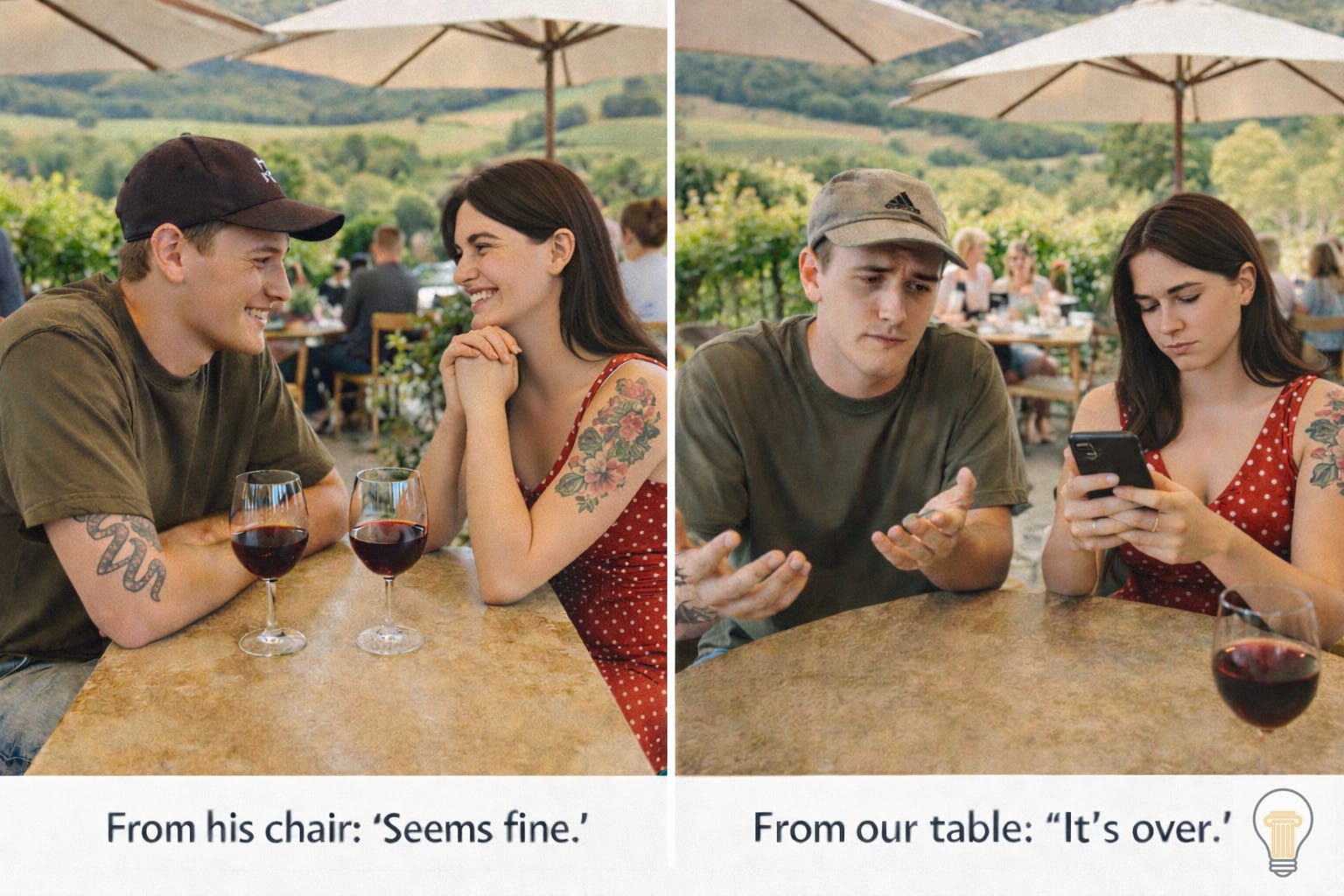
His date tried to engage. She asked questions. She offered openings. She threw conversational lifelines across the table.
He shrugged. Grunted. Dropped non-committal one-liners like loose change. All the while his date increasingly clinging to her red wine like a life-preserver.
Eventually she did what people do when the room has no oxygen left.
She reached for her phone.
And here’s the part D and I couldn’t stop musing about as we people-watched with morbid fascination:
Jarrod probably thought it went pretty well.
The Awareness Gap
From our table, it was obvious.
From his chair, it probably wasn’t.
That gap is the story, where the difference between how we think we’re showing up and how we actually are.
Most of us are like Jarrod sometimes.
I know I am.
After job interviews, people often ask me how it went.
My answer is almost always the same.
“I don’t know.”
In the stress of the moment, something narrows for me. My cognitive bandwidth collapses into survival mode. I’m focused entirely on answering well, thinking clearly, holding posture.
But I lose my meta-awareness.
I struggle to accurately read my own presence in the room. I can’t tell whether I expanded the space or shrank it. Whether I connected with the panel or just performed. I become… mechanical.
That’s the awareness gap.
We think the meeting went fine.
We think the pitch was solid.
We think we were engaged.
We think we were interesting.
Meanwhile, the other party is drifting. Quietly reaching for their metaphorical phone.
Presence is not what you feel.
Presence is what others experience.
And stress can be a great disrupter of that perception.
That distinction and awareness matters.
The Stoic Angle
The Stoics were obsessed with perception.
Not in the social media sense, but the epistemic sense. What is actually happening? What story am I telling myself? Where might I be wrong?
Marcus Aurelius constantly reminded himself that impressions are not reality. They are interpretations.
Jarrod, in my speculative people-watching reconstruction, was subject to his own internal narrative.
“I’m here.”
“I showed up.”
“I said things.”
“Seems fine.”
But being physically present and being consciously present are not the same thing.
In a distracted age, attention is moral currency.
When someone gives you their time and you give them half-formed sentences in return, that’s not an equal exchange. It’s an erosion of value.
The Adult Development Angle
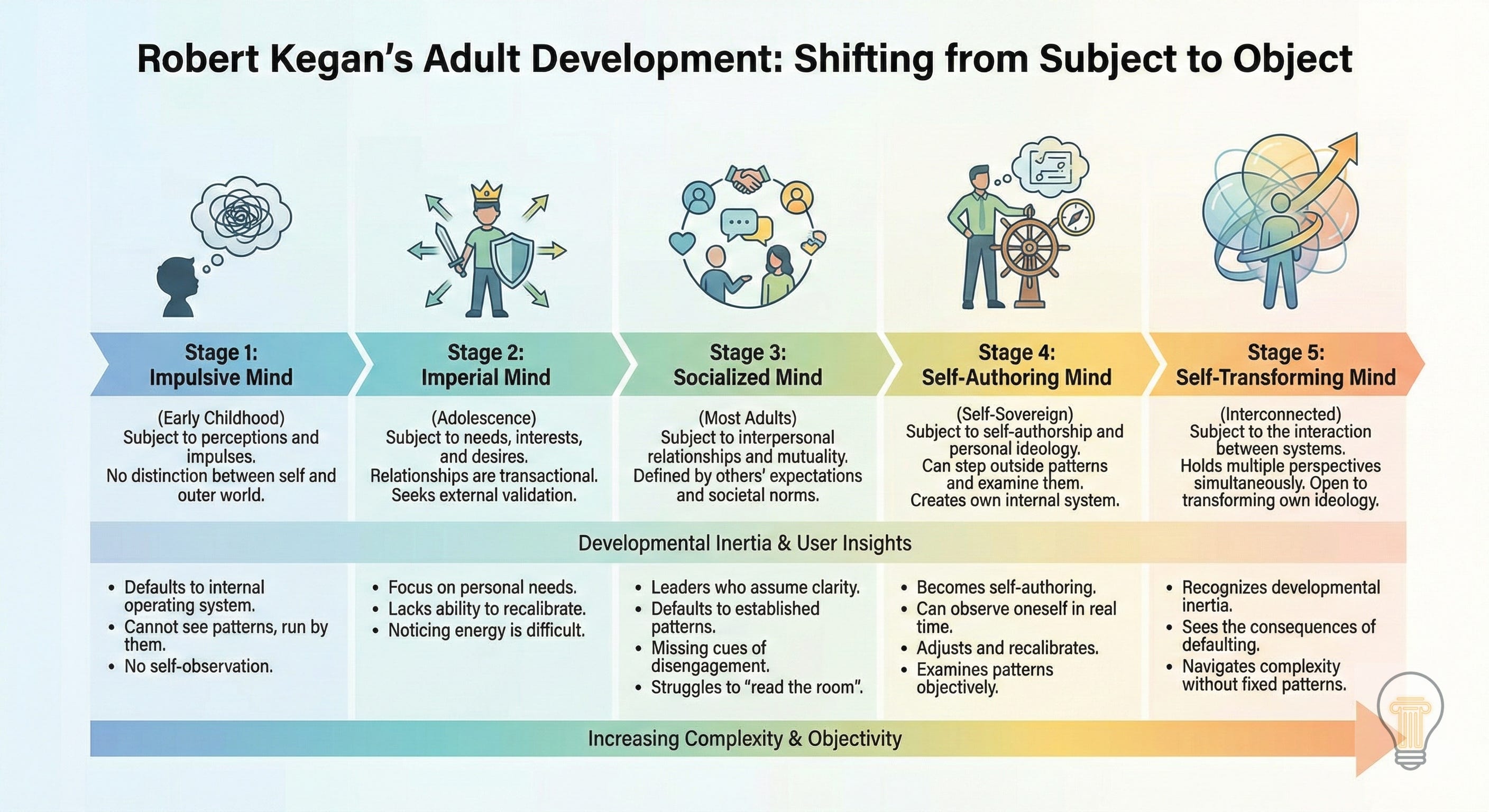
Robert Kegan’s work on adult development describes a shift many people never fully make (Kegan, 2016).
At earlier stages, we are “subject” to our internal operating system. We cannot see it. We are run by it.
At later stages, we become self-authoring. We can step outside our patterns and examine them.
Jarrod didn’t appear capable of observing himself in real time.
He wasn’t adjusting.
He wasn’t noticing her energy.
He wasn’t recalibrating.
He was defaulting.
That’s not a character flaw as much as developmental inertia.
But in professional life, developmental inertia has consequences.
Leaders who can’t read the room.
Academics who can’t see when students have disengaged.
Consultants who assume clarity while clients quietly lose confidence.
Phones come out in different forms.
In the Age of AI, Presence Is Leverage
Here’s the Stoic futurist twist.
As automation increases, the human advantage narrows.
Information is abundant.
Content is abundant.
Generated sentences are abundant.
The minimum benchmark for competence has quickly, albeit quietly, risen.
Drafting an email? Acceptable is easy.
Writing a strategy outline? Acceptable is easy.
Summarising research? Acceptable is easy.
AI can now get most people to “good enough” in minutes.
That changes the competence landscape.
When the floor rises, the differentiator changes too.
If everyone can produce competent work, the person who stands out is the one who exceeds that new baseline.
To be excellent at the same tasks, you now have to be that much sharper. That much clearer. That much more attuned.
The margin for mediocrity shrinks.
And it’s right there that presence becomes leverage.
I feel this most in job interviews. When stress narrows my awareness, I can perform competently. But competence is no longer the differentiator.
Because what isn’t automated is:
Real-time adjustment.
Emotional calibration.
Reading micro-signals.
Asking the better second question.
Sensing when the room has disengaged.
Jarrod wasn’t failing at a technical task.
He was failing at the one thing that remains scarce.
Attention.
In a world where competent output is increasingly assumed, what distinguishes you is how fully you show up.
Drifting through interactions is not neutral.
It’s becoming expensive.
Excellence is no longer just about what you produce.
It’s about awareness.
A Necessary Caveat
Of course, D and I could have been wrong.
Maybe he was nervous.
Maybe she’d already decided before dinner.
Maybe we projected a whole story onto two strangers over our pinot noir.
That’s worth admitting.
The Stoic move cuts both ways. We are also fallible observers.
But thankfully the principle survives the uncertainty.
There is always going to be an awareness gap.
The question is whether you care enough to close it.
Don’t Be a Jarrod
This post isn’t about mocking a stranger.
It’s about refusing to drift through your own interactions.
Ask yourself, occasionally:
Did I actually listen?
Did I expand the conversation?
Did I make the other person feel more interesting?
Did I adjust when the energy shifted?
Or did I just fill the space, occupy the chair?
In a world saturated with noise, shallow presence is easy.
Conscious presence is rare and increasingly valuable.
Don’t be a Jarrod.
Upgrade your attention.
When have you realised — too late — that the room had already left you?
Reply and tell me. I read every response.
If you’re interested in building that kind of awareness deliberately, I write weekly about judgement, resilience, and staying human in an automated age.
I am Jarrod. I have been aware of this for many years now. I have also learned that my presence depends heavily on the bond. On whether I feel safe enough to truly show up as myself. If I feel that safety and can utilize my natural talents, like Relator, then being present is effortless. But if I feel disconnected, I struggle immensely. Thank you for naming this gap; it is a constant dance between safety and awareness.