

The meeting notes were accurate. The judgement was wrong.
A manager starts using an AI meeting assistant for weekly 1:1s.
After one meeting, the summary looks flawless:
discussed Q3 deliverables
aligned on timeline
no blockers raised
So the manager moves on.
Three weeks later, their top performer resigns.
Nothing in the summary was wrong.
But it missed the reality of the meeting:
The heavy sigh before agreement.
The flat tone.
The pause after “I can make it work.”
The complete absence of enthusiasm.
The tool captured the words.
But, it stripped out the signal.
Saving time
is not always the same as preserving awareness.

Removing waste is not the same as removing effort
In Part 1, Asymmetric Action we made a clear claim:
Stop spending your best effort on work that disappears.
The obvious misuse of that idea is just as clear:
Assume all friction is waste?
It isn’t.
We are confusing two very different things:
administrative burden
the effort required for judgement
Removing the first improves performance.
Removing the second degrades it.
The automation trap
This failure mode isn’t new.
Lisanne Bainbridge identified it decades ago in what she called the Irony of Automation.
As systems become more reliable, human operators become less engaged with the underlying task and less capable of stepping in when the system fails (Bainbridge, 1983).
The paradox is simple.
Automation reduces the need for human involvement.
But when something breaks, the human is still responsible.
And now less prepared.
Translated to leadership:
The more you outsource noticing, synthesis, and interpretation,
the less capable you become at doing them when it matters.
The knee-jerk reaction is to blame the technology here, but this isn’t a technology problem.
It’s a contact problem.
What friction actually does
Modern work treats friction as the enemy.
Something to remove. Optimise. Eliminate.
But some friction isn’t waste.
Some friction is training.
Cognitive psychology makes this clear.
Research on desirable difficulties shows that effortful processing leads to stronger learning, retention, and transfer than easy processing (Bjork & Bjork, 2020).
In simple terms:
easy processing feels efficient
effortful processing builds capability
The implication is uncomfortable.
When you remove the effort from a task,
you often remove the mechanism that makes you better at it.
Reading a dense report forces synthesis.
Writing forces clarity.
Difficult conversations force judgement.
Remove the friction.
Lose the capability.
Required Friction
This is where our second pillar sits.
Required Friction is the deliberate retention of effort where that effort builds judgement, capability, empathy, or situational awareness.
It is not:
bureaucracy
manual work for its own sake
inefficiency
It’s a boundary.
A refusal to remove the effort that keeps you in contact with reality.
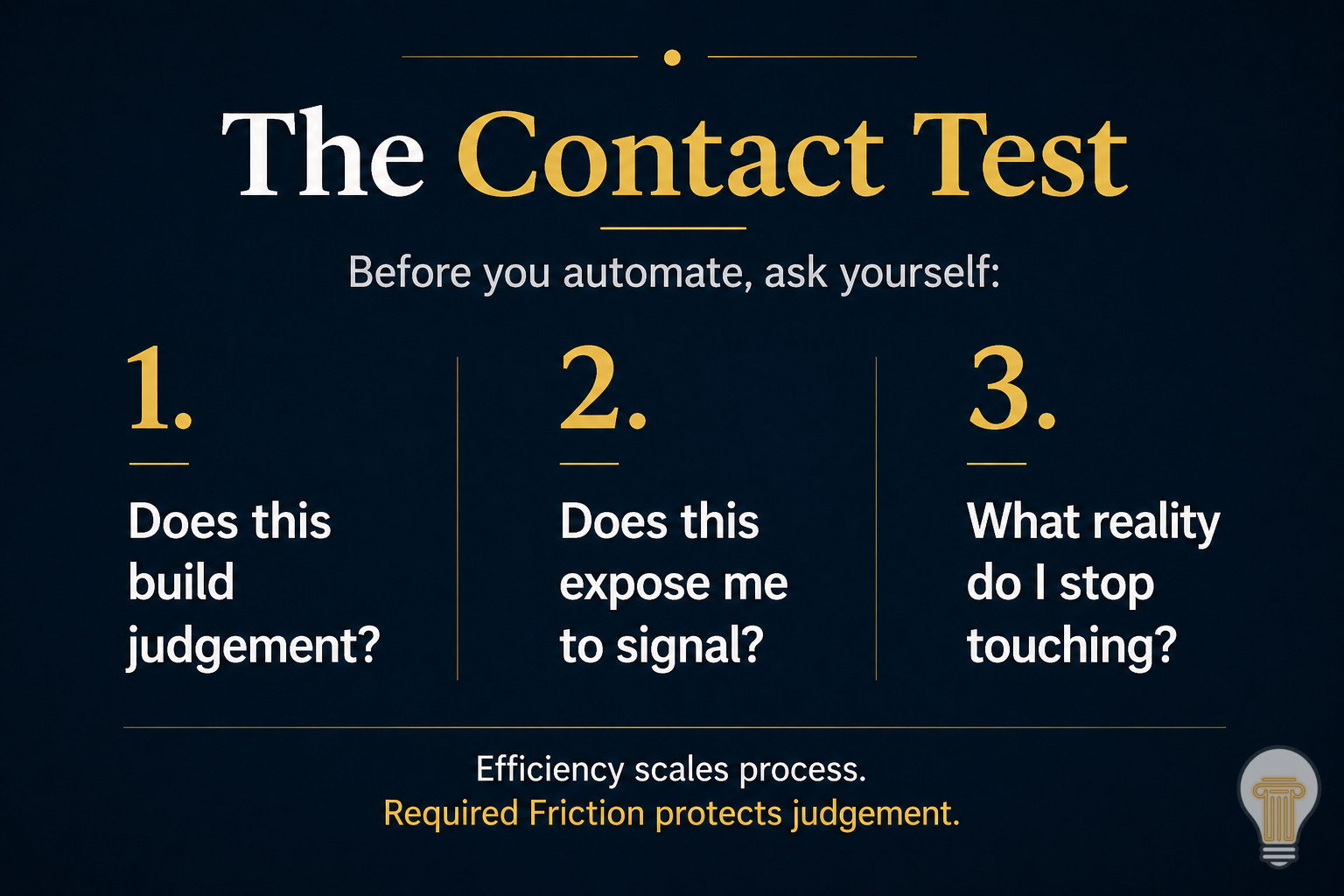
The Contact Test
Before you automate or remove a task, ask three questions:
1. Does doing this build judgement, or just consume time?
2. Does this expose me to nuance, ambiguity, or signal?
3. If I automate this, what reality do I stop touching?
If the task is administrative, remove the friction.
If the task builds perception, protect it.
Most people get this backwards.
They protect the work that drains them.
And outsource the work that develops them.
A practical boundary: capacity vs capability
The Contact Test helps you decide when to stay close to the work.
But it doesn’t tell you what kind of work you’re dealing with.
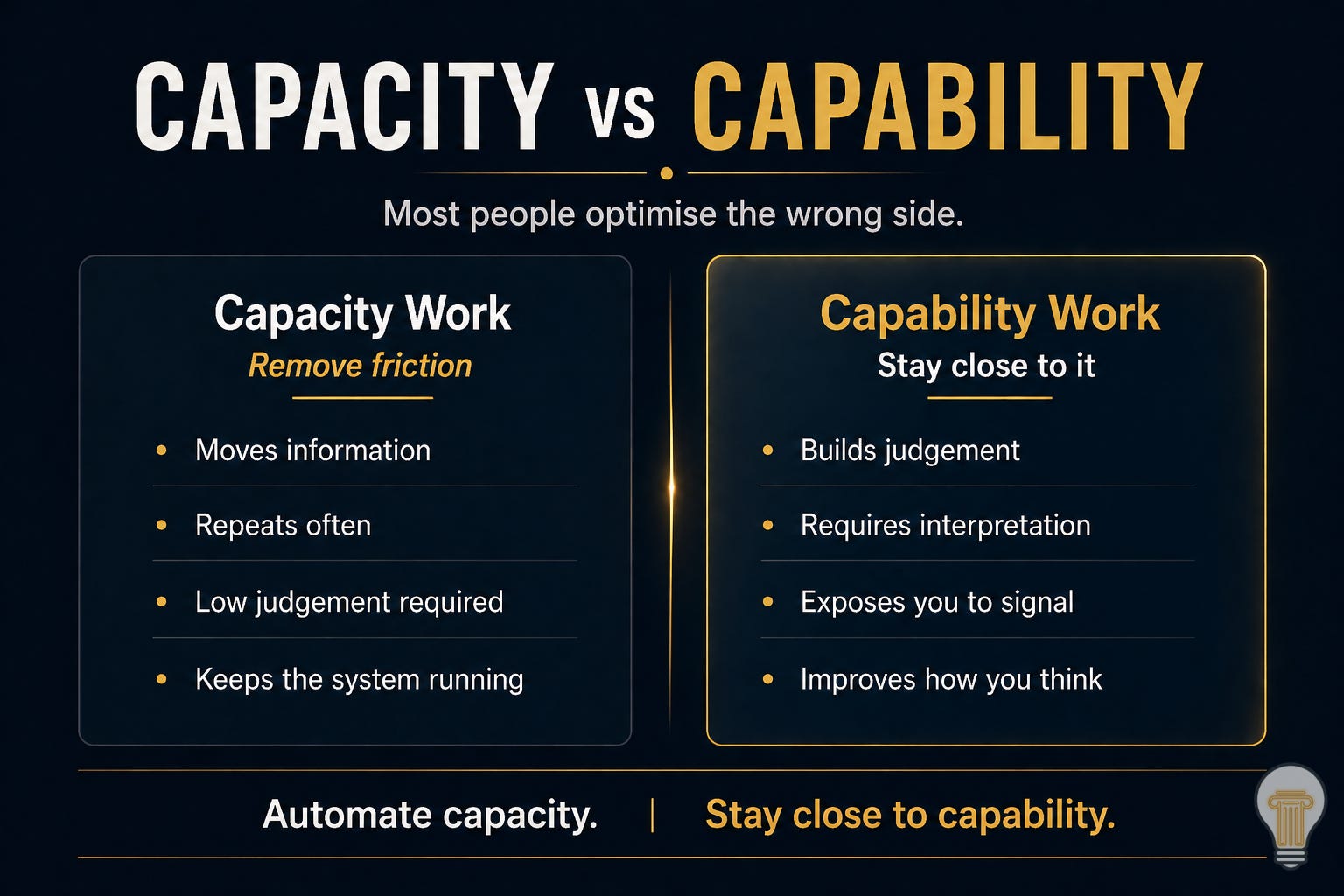
Most work falls into two categories.
Capacity work moves information:
scheduling
formatting
reporting
coordination
It keeps the system running.
You should remove as much friction here as possible.
Capability work builds judgement:
reading deeply
writing clearly
diagnosing problems
making decisions under uncertainty
having difficult conversations
It improves how you think and lead.
You should protect friction here.
Then anchor it:
If a task increases capacity, automate it.
If it builds capability, stay close to it.
What this looks like in practice
The friction of reading
Summaries are useful for orientation.
They’re dangerous when they replace contact.
The value of a 40-page report is not just its conclusion.
It’s the pattern recognition that happens while you wrestle with it.
The friction of writing
Writing is not the recording of a thought.
It is the act of forming one.
Completely outsourcing writing means outsourcing synthesis - the creation of new ideas.
The friction of judgement
Performance reviews, hiring decisions, strategy calls.
These aren’t data problems.
They are interpretation problems.
You can use tools to inform them.
You shouldn’t use tools to replace them.
The friction of connection
Empathy cannot be automated.
The discomfort of figuring out what to say to someone who is struggling
is the mechanism that builds trust.
Leaders lose range when they automate their own noticing.
The trade-off
Efficiency feels good. Really good.
It removes effort. Reduces time. Creates flow.
But it has a cost.
It reduces exposure to:
weak signals
ambiguity
contradiction
human nuance
These aren’t inefficiencies, but the raw materials of judgement.
The mandate
This week, identify one area where you have outsourced thinking to save time.
meeting summaries
performance feedback
strategic writing
decision-making
Take it back.
You don’t have to become analogue.
But reintroduce the friction.
Notice what returns:
context
signal
awareness
Efficiency scales process.
Required Friction protects your judgement.
Continue the series
Next: Calm Consistency
Why stable systems will beat bursts of intensity.
Start here: The Cognitive Firewall
I’m loving hearing about companies turning off AI note taking after realizing so many were tuning out and just simply reading the notes. Reduced engagement and critical thinking is not the byproduct we want.
Interesting reading.
I was working on summarizing this.
Time is manageable through scheduling, but attention requires protecting focus from distraction and fragmentation.
Attention management is fundamentally about mindfulness and prioritization, not just blocking time on a calendar.