
How Did Grievance Become Status?
To understand the culture, follow the incentives.

Something strange has happened in modern organisations.
Most people can feel it, although few could explain it.
Consider a familiar workplace.
A manager receives a complaint.
The complaint may be entirely justified.
HR gets involved.
Meetings continue.
Deadlines are met.
Yet something has changed.
People become more cautious.
The difficult conversations stop.
Feedback becomes more scripted.
Nobody says it aloud, but everyone senses it.
The organisational chart is unchanged.
The trust network certainly isn’t.
Nothing in the organisation’s policies explains what just happened.
Yet almost everyone recognises it.
We often describe moments like these as a “culture problem”.
Culture certainly matters.
But culture is usually the visible surface.
The deeper explanation lies elsewhere.
Human beings have always pursued status.
What has changed in societies is how that status should be earned.
Every civilisation, whether ancient or modern, answers the same question.
Who deserves admiration?
Those answers shape more than reputation.
They shape incentives.
Incentives then shape behaviour.
And, given enough time, behaviour shapes character.
Today’s debate about a “grievance culture” in workplaces is really a debate about status.
Not whether suffering exists. It plainly does.
Not whether injustice deserves attention. It plainly does.
The deeper question is why public expressions of grievance now carry such extraordinary moral weight.
How did grievance become status?
To answer that, we need to look much further back than the modern workplace.

When the Rules Changed
Historian Tom Holland argues that Christianity introduced one of history’s most profound moral reversals (Holland, 2019).
The Greco-Roman world admired strength.
Power signalled virtue.
The weak inspired little admiration.
Christianity overturned that hierarchy by placing a crucified victim at the centre of Western civilisation.
This changed more than theology.
It changed who deserved admiration.
Compassion for the vulnerable became not a weakness to be scorned but a moral obligation to intervene.
Over centuries, this transformation has reshaped Western assumptions about justice, equality and dignity.
Modern secular culture inherited much of that moral architecture.
Although, perhaps not all of it.
It retained the moral authority associated with victimhood while gradually shedding many of the accompanying obligations.
Grace.
Forgiveness.
Humility.
The possibility of redemption.
Whether one accepts Holland’s historical thesis in full or not, it helps explain why claims of victimhood continue to possess such extraordinary moral force in contemporary Western societies.
Sociologists Bradley Campbell and Jason Manning argue that this historical evolution has produced a new moral culture, one in which status is increasingly attached to demonstrated suffering rather than honour or dignity alone (Campbell & Manning, 2018).
They describe three broad moral cultures.
In honour cultures, reputation was defended personally.
Strength earned respect.
In dignity cultures, every individual possessed inherent worth.
Minor slights were expected to be tolerated.
Serious disputes were resolved through impartial institutions rather than personal vengeance.
In victimhood cultures elements of both are combined.
Like honour cultures, they treat relatively minor offences as morally significant.
Like dignity cultures, they appeal to third parties to resolve them.
The crucial difference here lies in how status is allocated.
Recognition increasingly flows towards those perceived to have suffered harm.
Whether or not one accepts every aspect of Campbell and Manning’s thesis, it explains why contemporary conflicts often feel so different from those of previous generations.
The rules of the status game changed.
The incentives changed with them.
Every Society Rewards Something
People respond to incentives.
Funnily enough, my father built his career in marketing on the back of that truth.
Change the rewards and behaviour changes with them.
Reward publications.
Academics publish.
Reward sales.
Salespeople optimise for sales.
Reward engagement.
Social media fills with outrage and attention-seeking.
Reward visible grievance.
Eventually, grievance acquires value.
Not because human nature suddenly changes.
Because the incentives have.
Institutional economist Douglass North argued that institutions shape behaviour by establishing the incentives governing human interaction (North, 1990). Elinor Ostrom likewise demonstrated that people adapt to the formal and informal rules embedded within their social systems (Ostrom, 2005).
The principle is remarkably consistent.
People optimise for whatever a system rewards.
That doesn’t make them uniquely virtuous or uniquely corrupt.
It makes them human.
Every status system trains the character it rewards.
That’s the deeper danger.
Not that a culture rewards certain actions.
That it silently forms certain kinds of people, and they have no idea that’s what is happening to them.
The Stoics understood this long before behavioural economics existed as a discipline.
They were less interested in changing the world than ensuring the world didn’t change them.
The question for the Stoics was never,
“What works?”It was,
“Who am I becoming?”
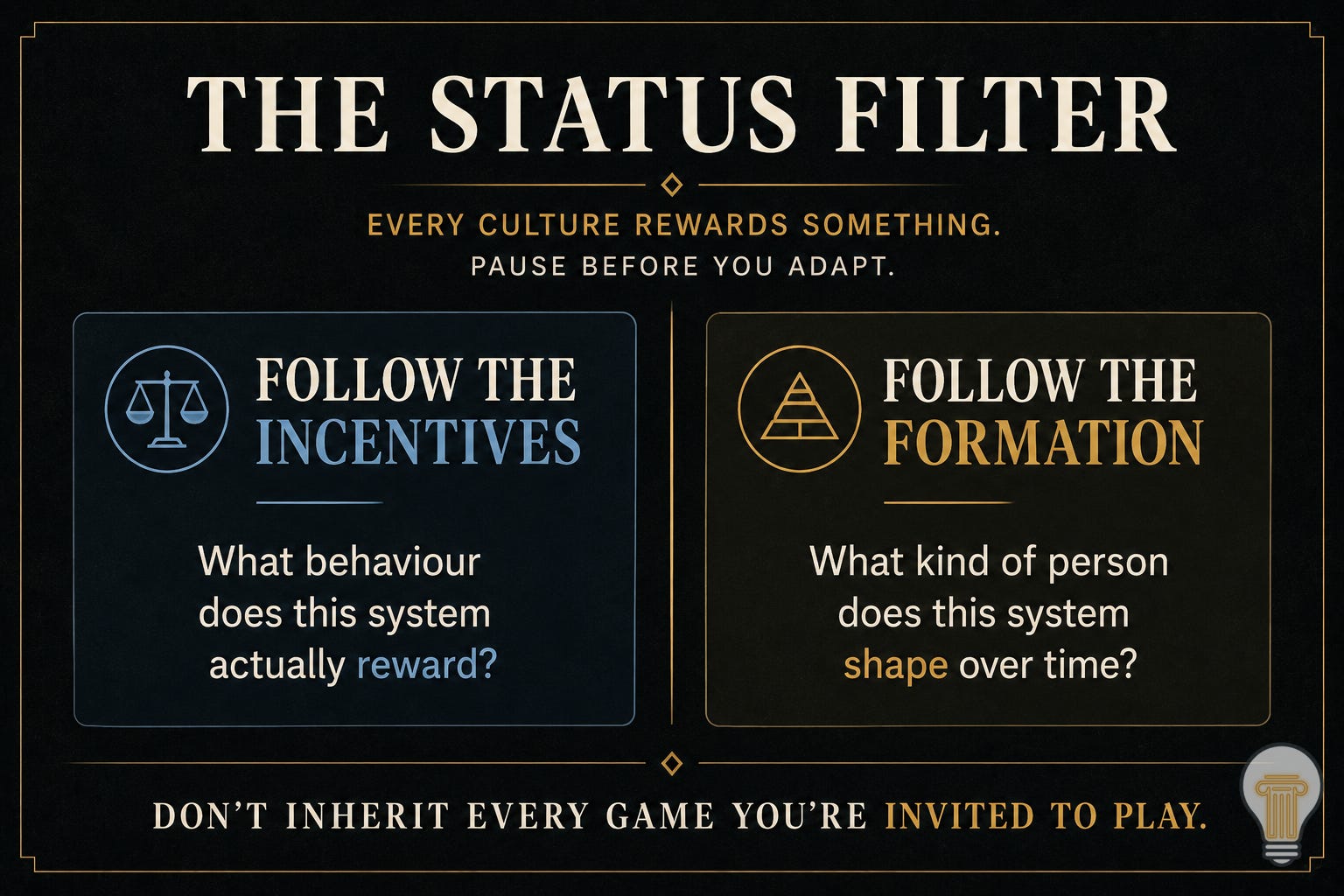
The Status Filter
Every culture teaches us what earns status.
Before adapting to it, pause.
Follow the incentives.
What behaviour does this system actually reward?
Watch what consistently receives attention, protection and prestige.
Systems reveal themselves through their incentives.
Follow the formation.
What kind of person is this system slowly training me to become?
Every incentive shapes behaviour.
Repeated behaviour shapes character.
The question isn’t whether the system works.
It’s whether the person it is forming is someone you want to become.
Every Status System Develops Specialists
None of this means people who raise grievances are acting strategically.
Most aren’t.
Many experience genuine injustice.
That distinction is important.
But every status system eventually attracts people who learn how to perform whatever that system rewards.
Researchers describe one manifestation of this dynamic as virtuous victimhood. Ok et al. (2021) found that individuals scoring highly on this also tended to score more highly on measures of Machiavellianism and narcissism - Dark Triad traits.
The important point isn’t that most grievances are manipulative.
There is a broader point here that:
Every status system eventually develops specialists.
The Stoics Asked a Different Question
The Stoics saw something different.
At StoiconX Sydney 2026, Tyler Paytas posed an inversion that has stayed with me since.
Most of us instinctively think injustice creates a moral emergency for the victim.
The Stoics, in contrast, argued that it creates a moral emergency for the perpetrator.
It’s moments like this that help us realise how saturated we are in our culture.
Marcus Aurelius repeatedly reminds himself that people do wrong because they misunderstand what is genuinely good (Meditations, 2.1).
Epictetus reaches much the same conclusion (Discourses, I.18).
Viewed this way, manipulation, cruelty and deceit reveal something tragic about people.
It’s not the damage caused, but the corruption revealed.
That changes the question.
Instead of asking,
“How could they do this to me?”we begin asking,
“What kind of person must someone become to behave this way?”
That shift doesn’t weaken accountability.
What it does is refuse to let another person’s behaviour become the architect of our own character.
The Only Status That Endures
Human beings will always pursue status.
Cultures will always decide how it is earned.
Organisations and Institutions will always reinforce those decisions.
Every status system will train the character it rewards.
The next time something in your organisation feels different, don’t begin with the culture.
Begin with the incentives.
Then ask the question the Stoics would have asked.
What kind of person is this system training me to become?
Every age invents a new status game.
Honour.
Wealth.
Credentials.
Followers.
Grievance.
The games change.
The temptation doesn’t.
The Stoics chose a different path.
They pursued the one form of status that no institution could award and no culture could revoke.
Status is borrowed.
Character is owned.
I enjoyed reading this. It made me realize I may be more stoic by nature than I realized. I experienced a very traumatic childhood and oddly I asked what kind of person is this creating in me, from a very young age and what kind of person would choose to do the things done to me. As a victim, I required resources I could not afford and therefore had to rely on society for help both financial and emotional, I was truly wrecked for a long time. Poverty- stricken Self advocation within systems designed for profit over people hurts more than helps because it legitimizes who "deserves" help and who doesnt based on cost. I also required choices I was not free to make as a victim in a profit driven society - time is money. Yet my mind was more focused on a much bigger picture. Who can we become after a perpetration of trauma? There is deep wisdom in contamplating our own moral character which the perpetrator tends not to do in the same way. Can these opposites ever be extracted from humanity? As a woman who has done the work not only to heal but to become fully aware of my own ability to see through the ugly truths of being human - I have come to understand the sway of influence no matter where from is a an opportunity to reflect and grow from there.
This is a very true and also unfortunate reality. Welcome to America. We gripe, hold on to past pains and sins, and want not only everyone else to fix us but also to provide for us. We have created a society of suicidal empathy and habitual feeders off of their hosts.