
The Dragon Was Always There
What Chesterton, AI anxiety and Stoic judgement can teach us about facing technological change

“Fairy tales do not give the child his first idea of the bogey.
What they give him is his first clear idea of its defeat.”
— G.K. Chesterton
You don’t need to be told there’s a dragon.
You already know.
It shows up differently now:
AI tools doing parts of your job faster than you can
expectations shifting without clear rules
a persistently recurring thought:
“Am I still as valuable as I was five years ago?”
Most content online will help you describe the dragon in more detail.
Very little will show you how to face it.
The modern dragon has a name
Let’s be clear.
AI anxiety is not irrational.
Disruption creates stress precisely because it forces people to change quickly and operate in uncertainty (Aarons-Mele, 2025).
More specifically, people feel threatened when three things are at risk:
competence
autonomy
belonging
When those are undermined, even capable professionals can feel exposed, even existentially (Hermann et al., 2026).
That tracks.
You’re not worried about “technology” as much as by:
whether your skills still matter
whether you still control your work
whether you still have a place
That’s not a technical problem.
It’s an identity problem.

The default response is making it worse
When people feel this pressure, they do what feels responsible.
They read more.
more tools
more predictions
more takes
It looks like progress.
It isn’t.
Because understanding the dragon in higher resolution doesn’t mean you’re any better at facing it.
In fact, modern AI environments are defined by “unknown unknowns”, where even experienced managers struggle to predict outcomes (Acar & Bastian, 2024).
And there’s a deeper problem.
As Herbert Simon observed (Simon, 1971):
“A wealth of information creates a poverty of attention.”
AI has just scaled that problem.
So you end up here:
More awareness.
Less clarity.
No action.
You’ve become fluent in describing the dragon.
You’re still untrained in dealing with it.
The Stoics already solved half of this
The Stoics had a simple way of dealing with uncertainty.
Divide the world into two parts:
what you control
what you don’t
Focus on the first. Accept the second.
It’s elegant.
It’s useful.
It’s incomplete.
Because knowing what you control doesn’t tell you what to do with it.
And that’s where most people stop.
They correctly identify that they don’t control:
AI development
organisational strategy
market shifts
Then they become observers of change rather than participants in it.
The Stoics gave us the boundary.
They didn’t give us a modern practice for operating inside it.
From control to capability
In the AI age, the question is not just:
What is in my control?
It’s:
What capabilities must I build to remain effective inside that control?
That shift is important.
Because most research points to the same conclusion:
Automation does not eliminate jobs wholesale.
It reshapes the tasks within them (OECD, 2023; McKinsey, 2023).
Which means the real pressure isn’t replacement.
But redistribution.
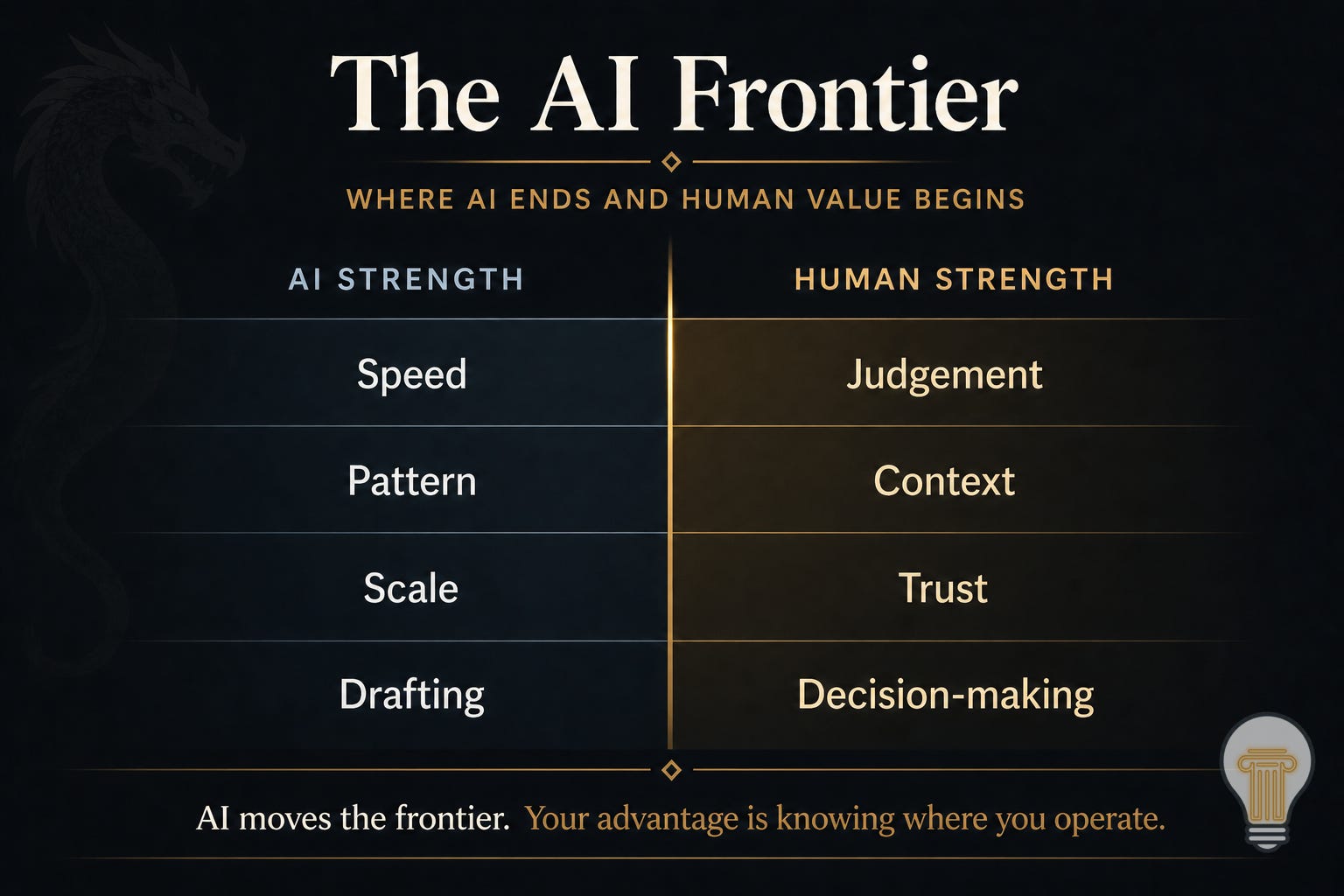
At the same time, AI is becoming extremely effective at:
calculation
prediction
pattern recognition
But far less reliable in:
judgement
context
decision-making under uncertainty
Even controlled studies show this clearly:
AI improves performance on structured tasks
but can reduce accuracy on more complex ones (Harvard Business School, 2023).
That’s the gap.
That’s where your leverage is.
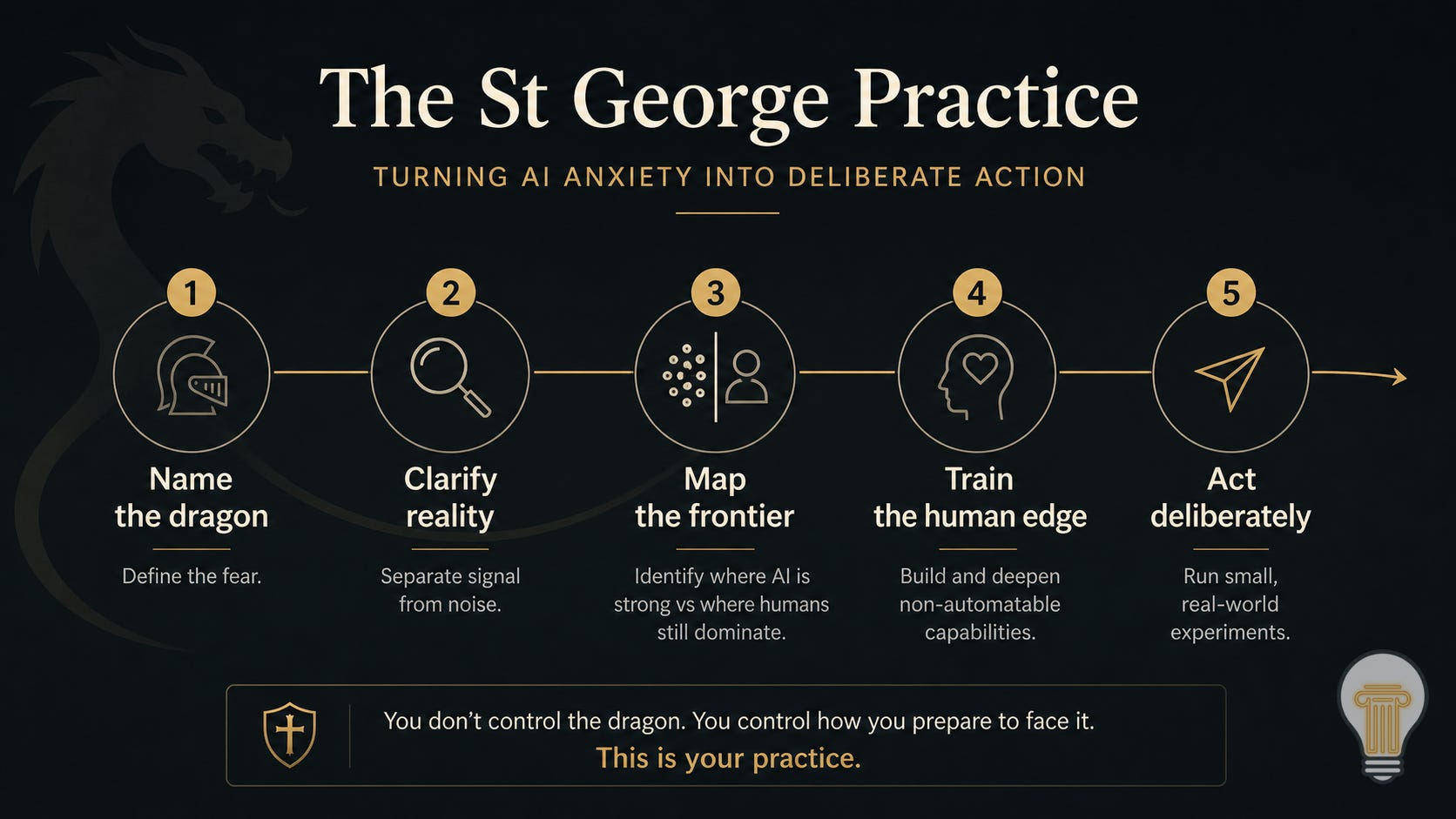
The St George Practice
Most people are waiting for clarity before they act.
That’s backwards.
Clarity comes from action.
Here’s a practical way to approach this.
1. Name the dragon
Be precise.
Not: “AI is a threat.”
But:
“What exactly am I afraid of losing?”
Until you define it, you can’t respond to it.
2. Clarify the reality
Separate signal from noise.
What is actually happening in your field?
What is speculation?
Most people are reacting to headlines, not evidence.
3. Map the frontier
AI doesn’t replace jobs.
It redraws the boundary between machine and human work.
Research shows that most roles are only partially automatable, with disruption happening at the task level, not the job level (OECD, 2023).
At the same time, AI performance is uneven:
It excels in some areas and fails in others.
That creates a frontier.
Your job isn’t to compete with AI inside that frontier.
But to operate just beyond it.
4. Train the human edge
As AI improves, value shifts.
Not to those who use it fastest.
But those who:
interpret it
challenge it
apply it wisely
Research into expertise consistently shows that human judgement becomes more valuable in uncertain, high-context environments where rules are incomplete (Kahneman & Klein, 2009).
That means investing in capabilities that don’t degrade with automation:
judgement
communication
domain insight
trust-building
These aren’t “soft skills” as we’ve been taught in the past.
They are non-automatable skills.
5. Act deliberately
Pick one action this week.
Not a course. Not a plan.
An action.
Use AI on a real task
Observe where it helps
Notice where it fails
That gap is your opportunity.
What this means for you
If you’re mid-career, competent, and nervously uneasy about where things are heading, you’re not alone.
And you’re not wrong.
But there’s a difference between:
feeling pressure
becoming passive under pressure
The real question is not:
“Will AI replace me?”
It’s:
“Which parts of me become more valuable when AI is everywhere?”
That question forces movement.
The other one leads to paralysis.
Back to the dragon
The baby has known the dragon for a long time.
That was never the problem.
The problem is that we’ve built a world that keeps pointing at dragons
and never trains the person who has to face them.
Chesterton had it right:
What matters is not the existence of the dragon.
It’s the existence of a St George.
In the AI age, that’s not a hero.
It’s a practice.
A way of thinking.
A way of acting.
A way of deciding under pressure.
Because the future will keep producing dragons.
Faster ones.
Stranger ones.
Less predictable ones.
The only real question is:
Are you becoming someone who can meet them deliberately?
This is the first logical and easy to apply solution to the fear of AI taking our jobs that I've seen.
Very smart and thought-provoking on several levels. I love author Joanna Penn's comment to AI bashers: "We just have to double down on being human." This article was a beautiful balance of heart and head. If you don't follow Andy O'Bryan, he is doing really good work in the area of hw to humanize AI.