

A high-performing colleague recently asked me what I meant when I said I “run things past my AI”.
It was a fair question.
For many professionals, AI still means one of three things:
A faster intern.
A cleaner search engine.
A machine that turns rough notes into acceptable prose.
That’s useful. I use it that way too.
But it’s also the least interesting use case.
The deeper value of AI isn’t that it saves us from thinking. It’s that, used properly, it makes our thinking harder to hide from.
It can expose the assumptions smuggled into a strategy.
It can surface contradictions in our reasoning.
It can help us model futures we would rather not consider.
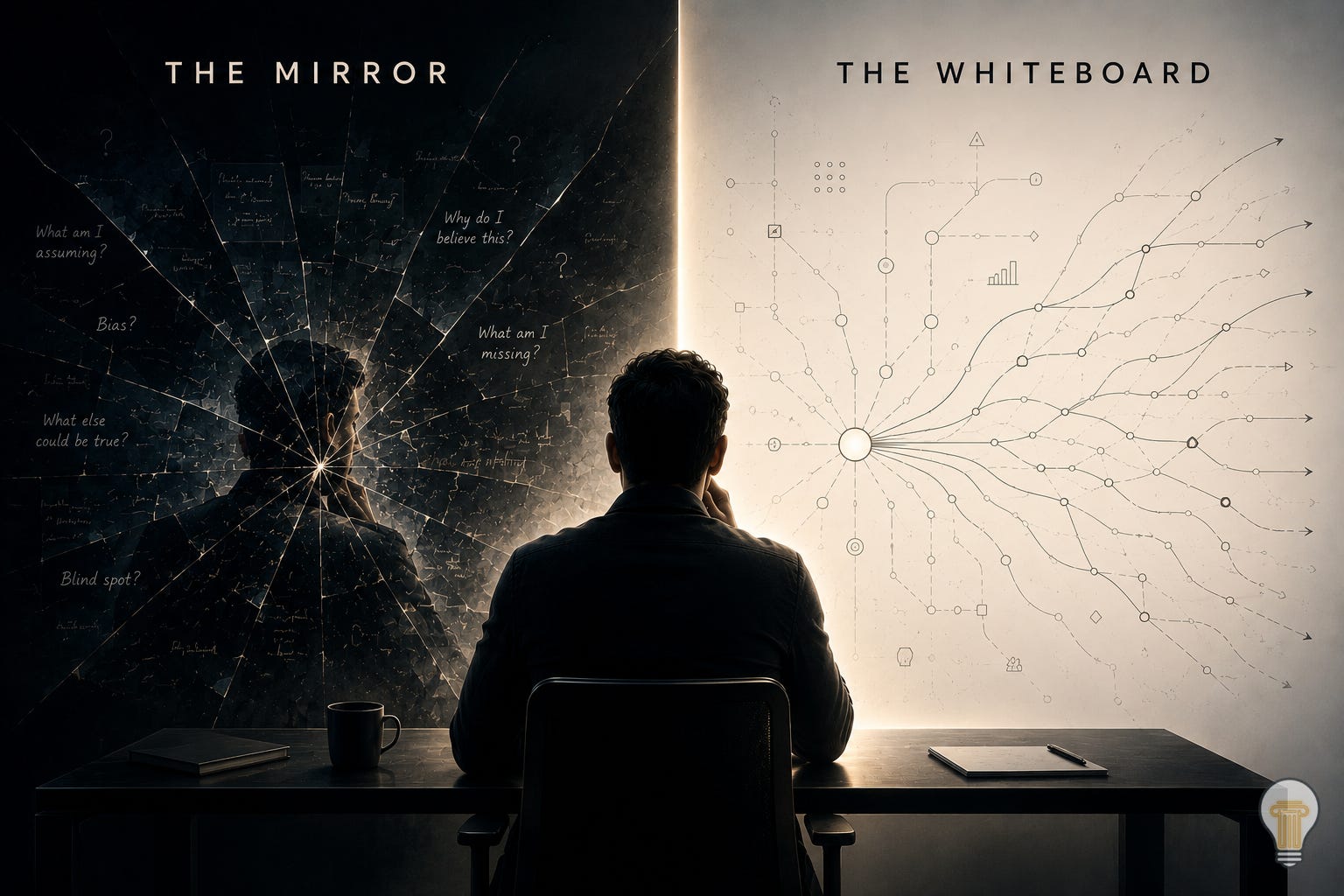
In that sense, I’ve started thinking about AI through two primary roles:
The Mirror.
The Whiteboard.
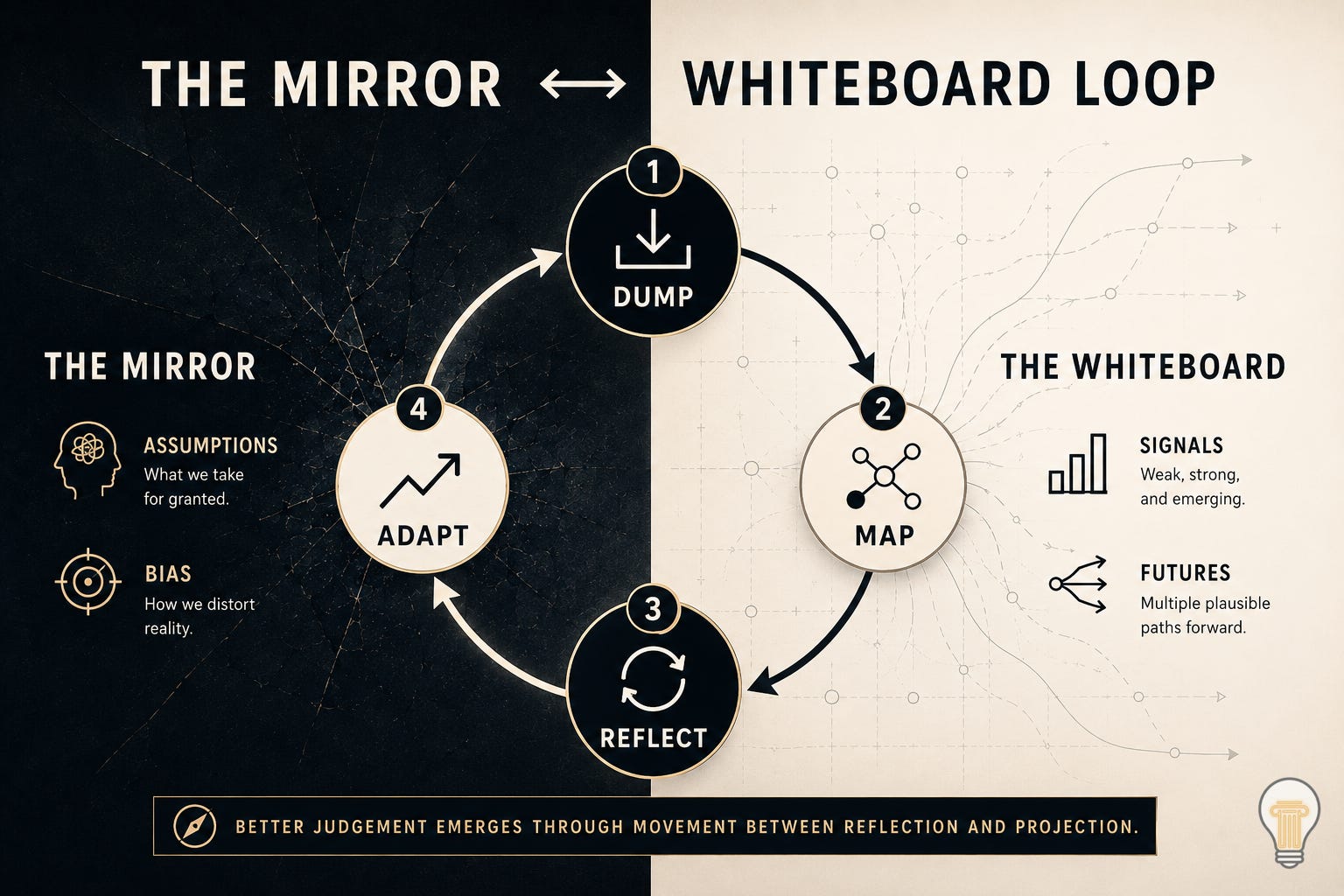
The Mirror reflects how we are thinking.
The Whiteboard helps us explore what might happen next.
Most people are still using AI as an intern.
The more interesting question is what happens when we start using it as a cognitive environment instead.
The AI Intern Trap
There is a strange irony emerging in the professional world.
The more powerful AI becomes, the more tempting it is to outsource the exact skills that make people valuable in the first place.
Judgement.
Discernment.
Strategic thinking.
Sensemaking.
A growing number of professionals now spend their days feeding half-formed prompts into increasingly capable systems, then mistaking speed for clarity.
But fast output is not the same thing as good thinking.
In fact, some early research suggests the opposite may happen. The Upwork Research Institute found that generative AI often shifts workers from “doing” into continuous evaluation and verification, increasing cognitive load rather than eliminating it (Upwork Research Institute 2024).
That finding is important.
Because it means AI does not remove the need for thinking carefully. It increases the consequences of thinking badly.
Weak assumptions can now scale faster than ever.
So can shallow strategies.
So can organisational and institutional delusions.
The organisations and leaders who benefit most from AI won’t necessarily be those generating the most content or automating the most tasks.
They’ll be the ones who use AI to sharpen judgement rather than bypass it.
The Mirror
The Mirror is the simplest albeit most confronting use of AI.
It’s not there to tell you the truth.
It’s there to reflect the quality of your current thinking.
If your assumptions are muddled, the reflection will usually be muddled too.
If your reasoning is shallow, AI often amplifies the weakness rather than correcting it.
But if you know how to interrogate your own thinking, something interesting happens.
The machine starts functioning less like an oracle and more like externalised metacognition.
In other words, you begin seeing your reasoning in front of you.
Not inside your head.
That distance is important.
Why? Because many of the worst strategic errors are not caused by lack of intelligence. They are caused by invisible assumptions operating unchecked beneath the surface.
The Mirror introduces friction.
Good friction. Required Friction.
The kind that forces a pause long enough to ask:
What am I assuming here?
What would make this fail?
What incentives am I ignoring?
What am I emotionally attached to?
Where might I be rationalising rather than reasoning?
I use this constantly.
Before major decisions.
Before publishing ideas.
Before strategic conversations.
Before mentoring founders.
Before committing to long-term plans.
Not because AI is wiser than I am.
But because it’s useful at making implicit reasoning more visible.
And visibility changes the quality of our judgement.
The Official Future
Scenario planning pioneers like Pierre Wack and Peter Schwartz argued that most organisations unconsciously operate from an “Official Future” — an assumed version of tomorrow that feels so obvious nobody bothers questioning it (Wack 1985; Schwartz 1996).
Growth will continue.
The market will remain stable.
Customers will behave roughly the same way.
Institutions will adapt slowly enough for current systems to survive.
These assumptions rarely appear in strategy documents explicitly.
But they subtly shape almost every decision.
The danger isn’t that these assumptions exist.
The danger is that they become invisible, and without warning.
This is where AI becomes useful as a Mirror.
Not because it predicts the future.
Rather, it helps expose the future we’re already assuming.
Recent scenario planning practitioners have started using generative AI specifically to surface these hidden “ghost scenarios” and latent strategic assumptions before they collide with reality (Mössinger 2025).
That framing heavily influenced what I now call the Ghost Protocol (articulated later in this article).
That distinction is enormous.
Many leaders are currently using AI to accelerate execution.
Far fewer are using it to interrogate the assumptions underneath the execution itself.
That’s the more interesting use case.
The Whiteboard
If the Mirror is about reflection, the Whiteboard is about synthesis.
The Whiteboard is where AI becomes genuinely powerful.
Again, not as a replacement for human thinking.
As an amplifier for structured exploration.
One of the hardest parts of modern professional life isn’t information scarcity.
It’s the opposite. Information overload, without coherent integration.
Signals arrive from everywhere:
Technological shifts.
Institutional incentives.
Changing labour markets.
AI capability jumps.
Economic pressure.
Cultural fragmentation.
Personal ambition.
Family constraints.
Most people carry these fragments around mentally without ever externalising them into something workable.
The Whiteboard changes that.
It gives you a low-stakes environment to drag abstract thoughts into visible space and start mapping relationships between them.
Patterns emerge faster.
Second-order effects become easier to see.
Contradictions become harder to ignore.
The World Economic Forum and OECD recently highlighted that foresight practitioners are increasingly using AI not to predict singular futures, but to accelerate scenario exploration and identify signals of change across complex systems (World Economic Forum 2025).
That framing is important.
The value isn’t in certainty.
The value is in range.
The Whiteboard is where you ask:
What happens if this trend accelerates?
What happens if this institution fails to adapt?
What tensions emerge if these two systems collide?
What future am I structurally unprepared for?
Used properly, AI compresses the heavy lifting of synthesis.
Which leaves the human operator with the highest-leverage task:
Judgement.
The Philosopher Executive
This is where I think a major divide is beginning to emerge.
Many professionals still approach AI tactically.
“How do I save time?”
“How do I automate tasks?”
“How do I generate more content?”
Reasonable questions.
But increasingly insufficient ones.
The people who gain disproportionate advantage from AI over the next decade will likely be those capable of integrating technical literacy with philosophical literacy.
People who can think across systems.
People who understand incentives, institutions, psychology, and second-order effects.
People who can sit with ambiguity long enough to form an actual thought before outsourcing the process to the machine.
In other words:
The edge may belong less to the technician alone, and more to the philosopher executive.
The strategist capable of combining reflection with synthesis.
The Mirror and the Whiteboard.
The Ghost Protocol
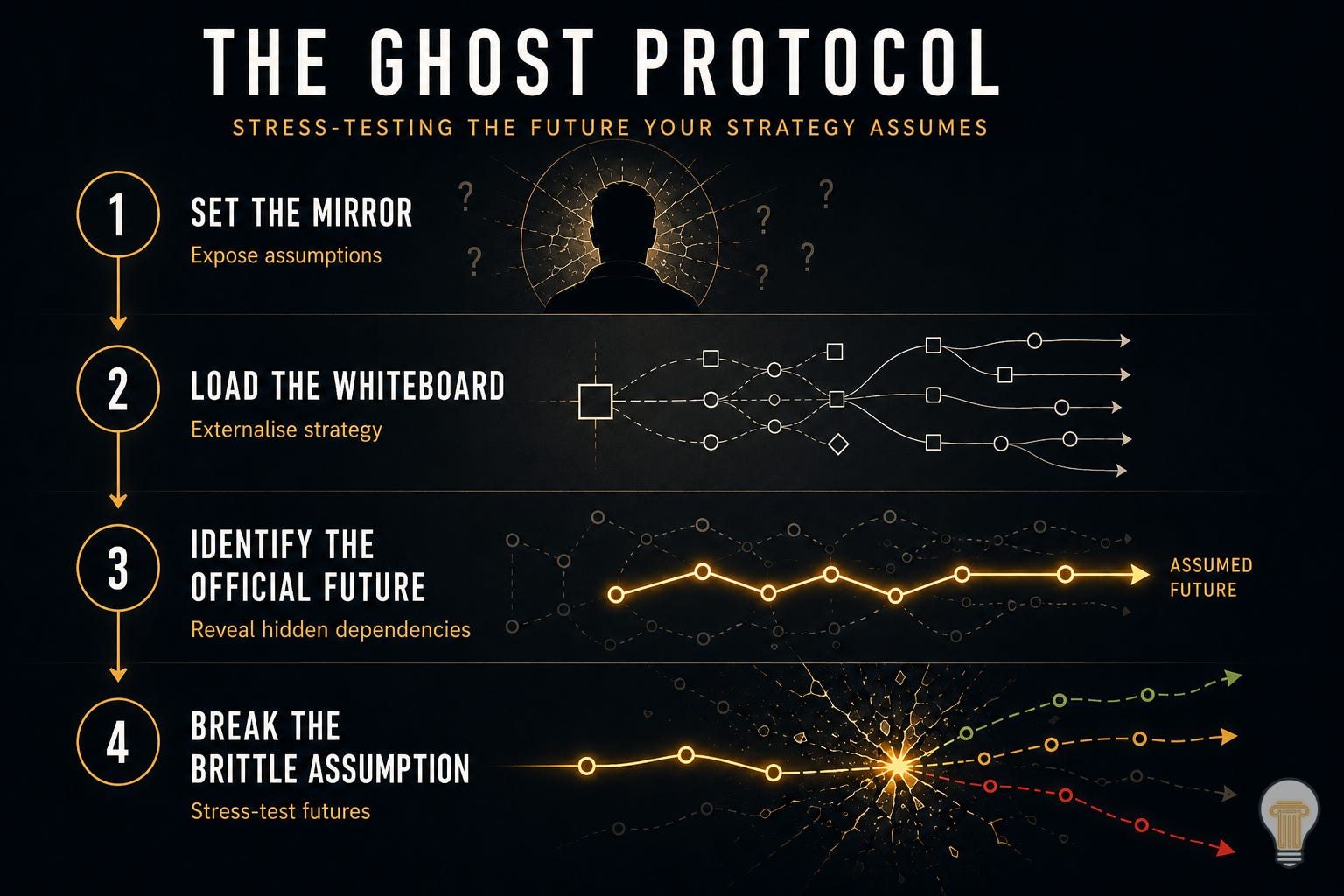
Over time, I developed a simple process for stress-testing plans and assumptions using AI.
I call it the “Ghost Protocol”.
It’s not about predicting the future.
It’s designed to expose the future your strategy secretly depends on.
Here is the process.
Turn 1: Set the Mirror
“Act as a strategic red team. Your role is not to validate my plan, but to expose the unstated assumptions beneath it. Be rigorous, specific, and direct.”
Pause after the response.
The pause always matters.
The goal is to mentally shift from persuasion mode and into examination mode.
Turn 2: Load the Whiteboard
“Here is the strategy I am considering.
Objective: [insert goal]
Current context: [insert context]
Main levers: [insert actions]
Constraints: [insert constraints]
Reply only with: ‘Strategy logged. Ready for audit.’”
Again, pause.
Don’t rush.
The point is not instant optimisation.
The point is structured externalisation.
Turn 3: Identify the Official Future
“Identify the three assumptions that must remain true for this strategy to succeed. Do not advise yet. Just isolate the assumed future underneath the plan.”
This is usually the most revealing step.
Because many plans collapse the moment the hidden assumptions become visible.
Turn 4: Break the Brittle Assumption
“Take assumption #2 and generate three plausible scenarios where it fails due to market, technological, institutional, or behavioural shifts. Show where the strategy breaks and what early warning signals I should monitor.”
Now the interesting work begins.
Not prediction.
Preparation.
The goal isn’t certainty.
It’s cognitive resilience.
One important note:
Do not paste the entire sequence into the machine at once.
That defeats the purpose.
The value is in the friction between turns.
The pause is part of the thinking.
AI-In-The-Loop
The strongest AI users I know are not passive consumers of machine output.
They are active participants in iterative reasoning.
They think with the system, not beneath it.
The Whiteboard externalises complexity.
The Mirror sharpens judgement.
The human remains responsible for interpretation.
That last bit is important.
Because the danger isn’t that AI will think for us.
The more immediate danger is that we stop noticing when we are no longer thinking carefully ourselves.
Even as AI systems become more capable, institutions like MIT Sloan Management Review continue to emphasise the importance of human oversight, strategic judgement, and organisational learning in effective AI adoption (Davenport & Bean, 2025).
The future won’t belong to the people who automate everything.
It will belong to the people who retain agency while operating inside increasingly intelligent systems.
Not machine dependence.
Cognitive partnership.
That is a very different philosophy of technology.
And I suspect it’ll matter far more than most people realise.
I’m curious, what is one assumption, strategy, or future you would run through the Ghost Protocol right now?
Very smart approach to AI. Will use this as inspiration to ask better questions about my work.
Really enjoyed this. Friction with AI is enormous leverage for those willing to do the work of confronting it.