

Why this exists
We’re not short on information.
We’re short on judgement.
AI didn’t create this problem. It exposed it.
The modern professional environment is a constant stream of:
confident claims
urgent predictions
persuasive tools
dashboards pretending to be wisdom
The risk isn’t that machines will think for us.
It’s that we’ll stop noticing when we’re no longer thinking at all.
This guide is not about resisting technology.
It’s about **using it without surrendering agency**.
Stoic Futurism is a simple stance:
Accept the pace of change.
Refuse to outsource judgement.
Act deliberately inside what you can control.
What follows is a **Cognitive Firewall**.
Not software.
A set of mental checks you can run before you believe, share, buy, automate, or comply.
Use it quietly. Often.
Part I: The Cognitive Firewall
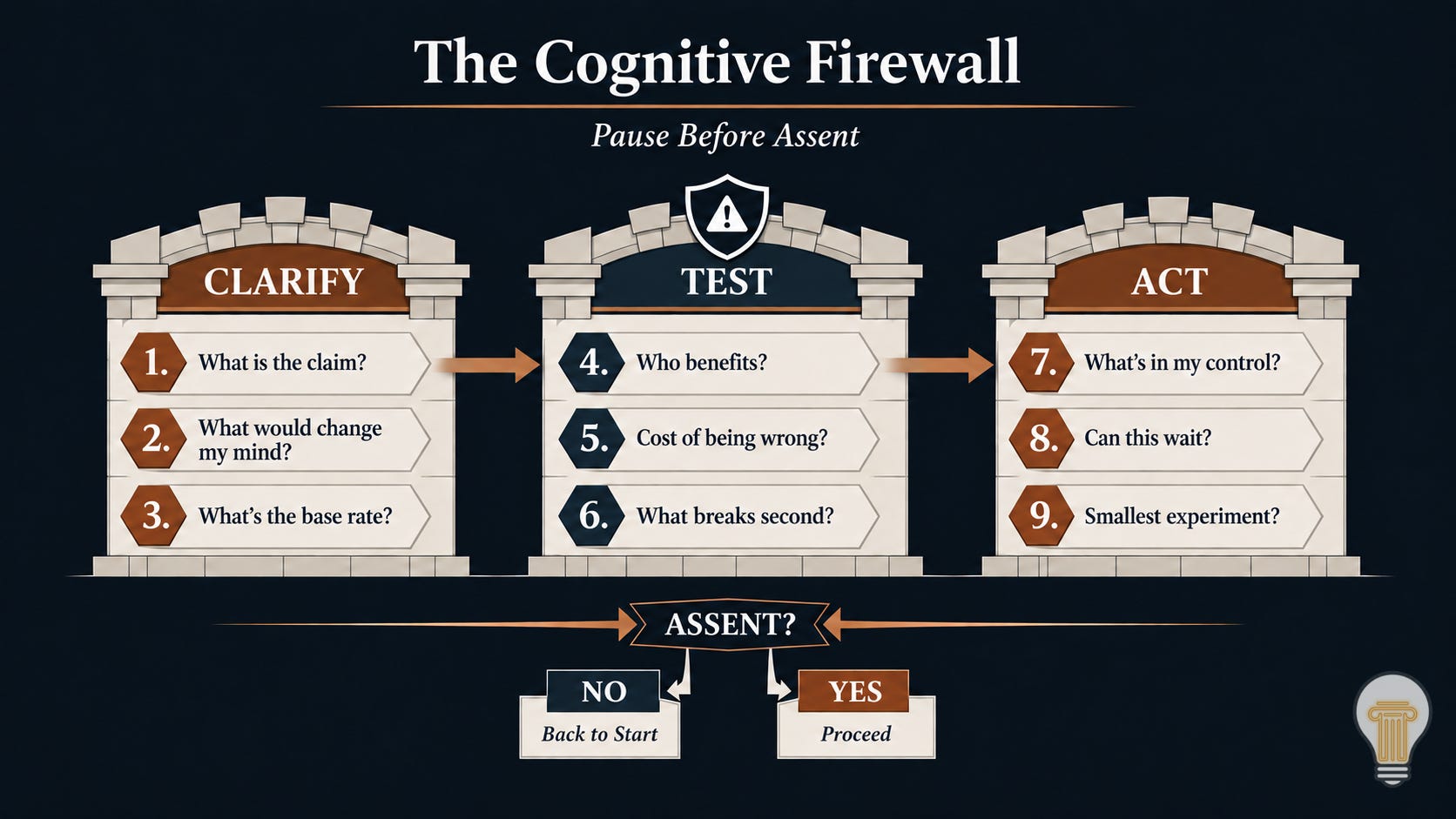
Nine questions to run before assent
The Stoics called it *assent*: the moment you accept an impression as true.
That moment now arrives faster than ever.
These questions slow it down.
1. What is the exact claim?
Rewrite the claim as a single, testable sentence.
Not:
“AI will transform education.”
But:
“Within three years, generative AI will replace 30 percent of assessment tasks in Australian universities.”
If you can’t restate the claim precisely, it’s not a claim. It’s mood music.
2. What would change my mind?
Name the evidence that would *falsify* the claim.
If the answer is “nothing”, you’re dealing with belief, not analysis.
Strong claims should be fragile.
3. What’s the base rate?
How often does this kind of thing actually happen?
Most “disruptions” don’t disrupt.
Most “revolutions” settle into bureaucracy.
Most pilots never scale.
Base rates are boring. That’s why they matter.
4. Who benefits if I believe this?
Follow incentives, not intentions.
Ask:
Who gains authority?
Who sells tools, training, or reassurance?
Who avoids responsibility?
This doesn’t mean the claim is false.
It means it’s interested.
5. What’s the cost of being wrong?
Not just reputational. Practical.
Time wasted.
Trust eroded.
Skills neglected.
Decisions deferred.
Low cost? Experiment.
High cost? Slow down.
6. What breaks second?
First-order effects are obvious.
Second-order effects do the damage.
Ask:
What behaviours will this encourage?
What will people stop doing if this becomes normal?
What new dependencies does it create?
Most failures happen here.
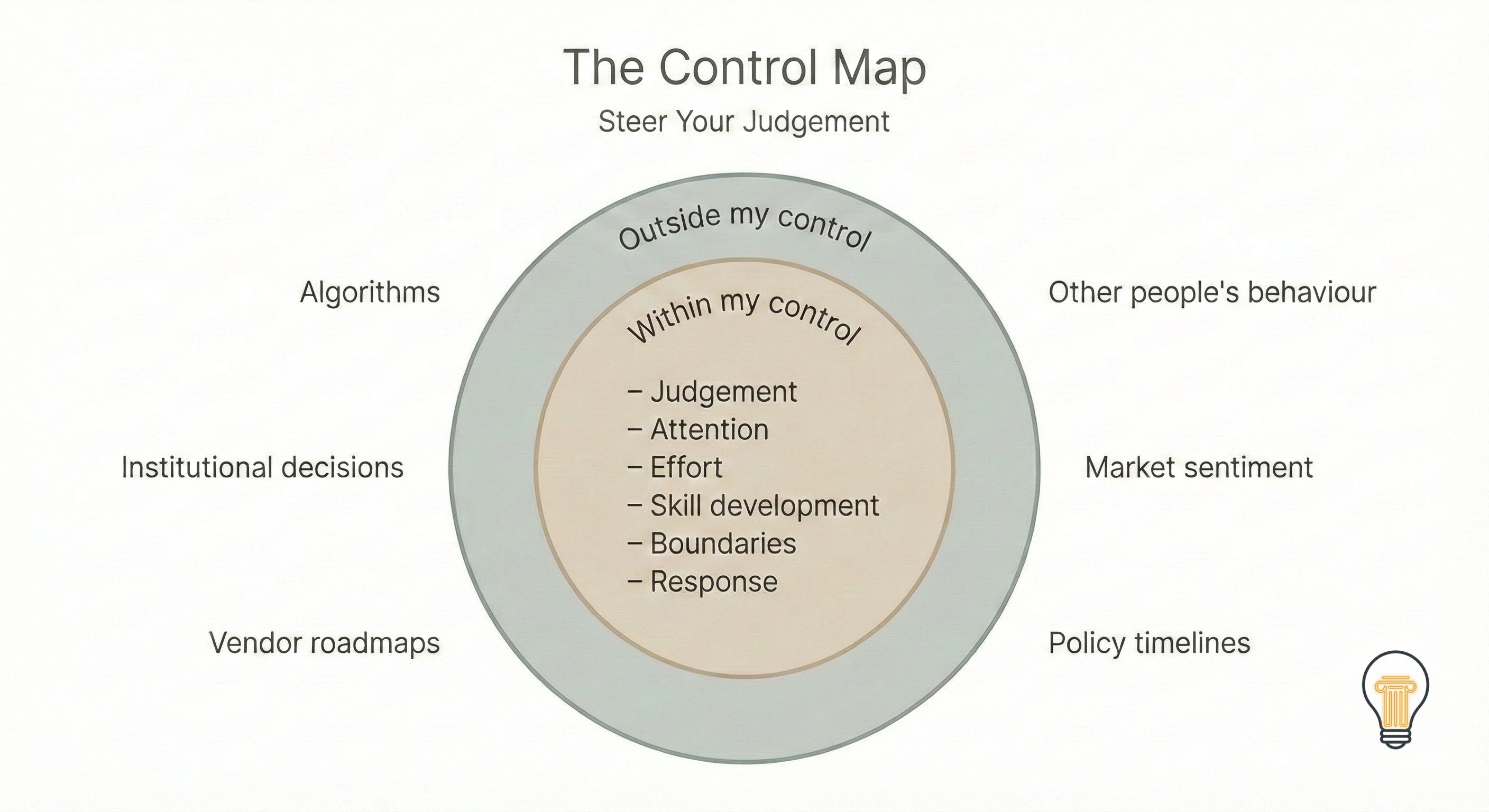
7. What is actually in my control?
Strip away:
policy debates
vendor roadmaps
executive speeches
What remains?
One decision. One habit. One boundary.
Focus there.
8. What can I safely ignore for seven days?
Urgency is usually synthetic.
If ignoring something for a week causes real harm, it was important.
If nothing changes, it was noise.
Attention is a finite budget.
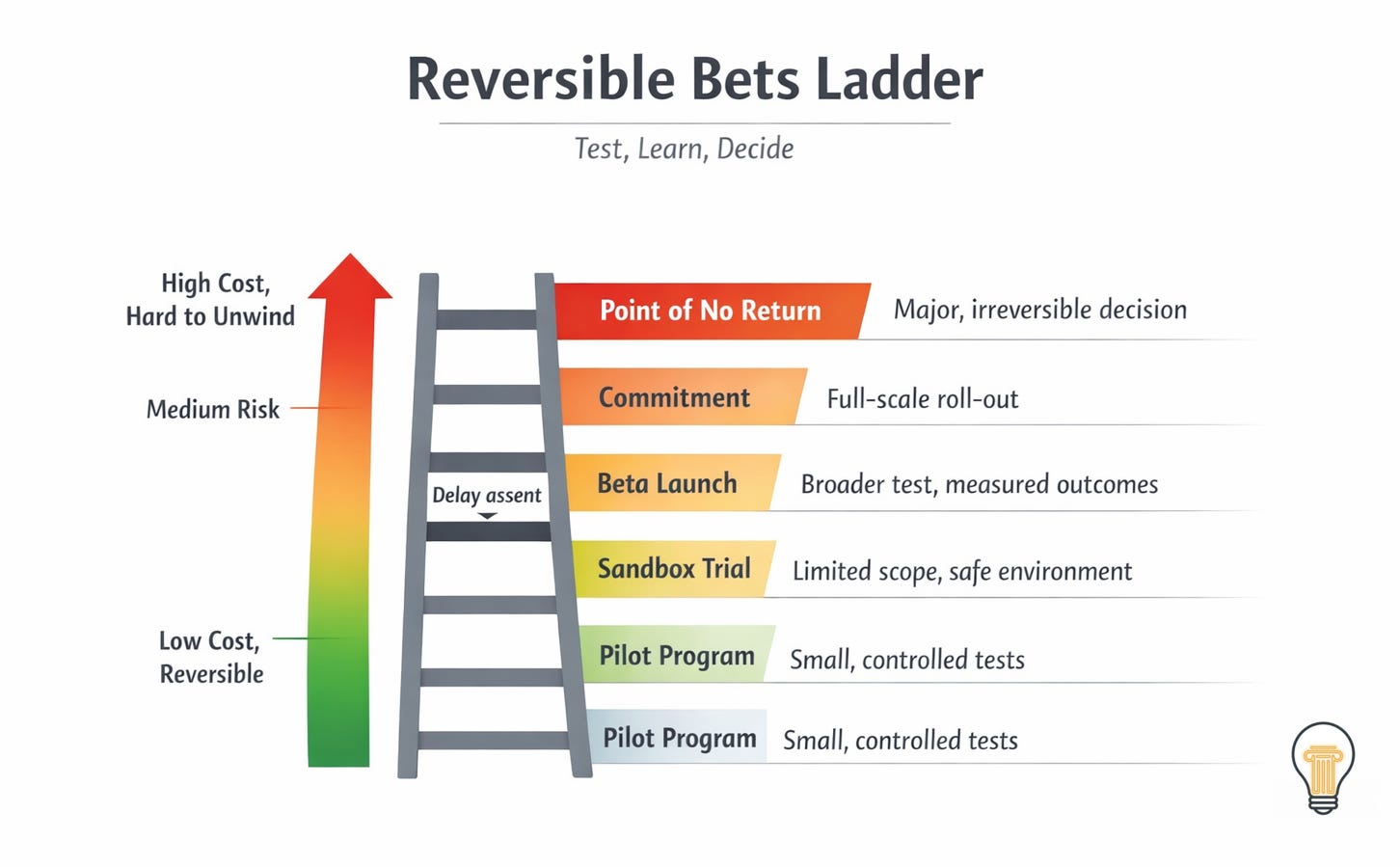
9. What’s the smallest reversible experiment?
Avoid grand commitments.
Prefer:
trials
sandboxes
limited scope tests
opt-out clauses
Stoicism favours reversible action over heroic certainty.
Part II: The Calm Kit
Mental models that scale under pressure
These aren’t inspirational. They’re load-bearing.
1. Dichotomy of control
Some things respond to effort.
Others don’t.
AI roadmaps, institutional politics, market sentiment: not yours.
Your judgement, skill development, and conduct: yours.
Confusing the two causes anxiety and poor decisions.
2. Premeditatio malorum (the pre-mortem)
Before adopting a tool or strategy, imagine it failed.
Ask:
Why did this go wrong?
What did we underestimate?
Who paid the price?
Design around that failure now, not later.
3. Assent discipline
You don’t have to accept every thought that appears.
“Interesting” is not “true”.
“Impressive” is not “necessary”.
“Popular” is not “inevitable”.
Delay assent. Choose deliberately.
4. Opportunity cost
Every yes funds a no.
Every dashboard you monitor replaces something else.
Every automation you adopt reshapes skill demand.
Every shortcut trades learning for speed.
Nothing is free. Especially convenience.
5. Second-order thinking
If this works perfectly, then what?
If everyone adopts this, then what?
If this becomes policy, then what?
Most systems fail at scale, not at launch.
Part III: Tools, used properly
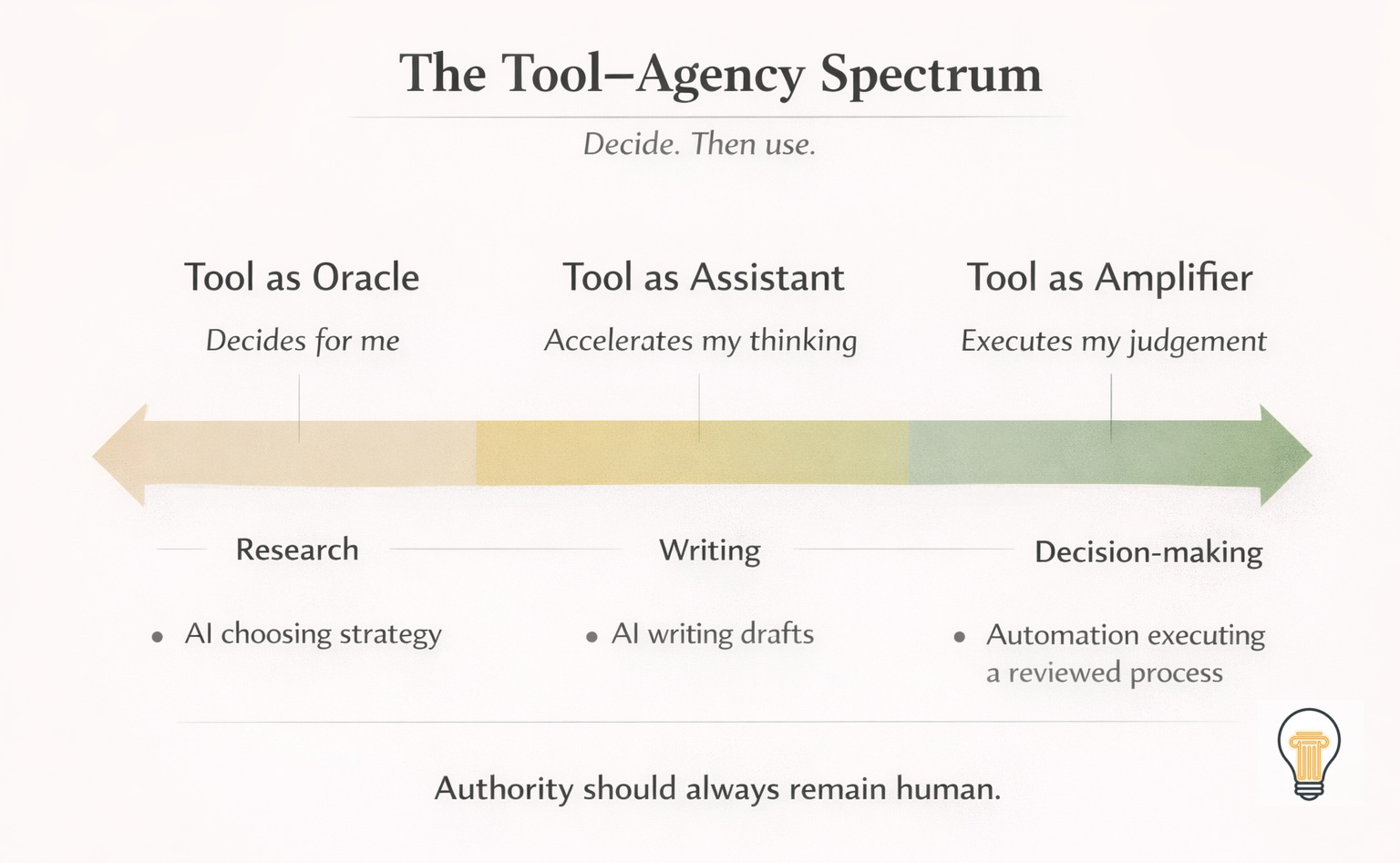
Assistants, not oracles
Tools are neutral. Posture is not.
Tool category 1: Reading and synthesis
Use tools that:
capture what you read
highlight what mattered
surface patterns over time
The goal is memory augmentation, not content hoarding.
If your system saves everything but changes nothing, it’s decorative.
Tool category 2: Thinking spaces
Notes systems should:
let ideas collide
preserve your words, not just excerpts
show evolution over time
If AI writes your notes for you, you lose the trail of thought that makes them useful.
Tool category 3: AI as research assistant
Treat AI like a capable intern:
fast
confident
occasionally wrong
Always ask:
“What are the assumptions here?”
“What sources support this?”
“What would a sceptic say?”
Never ask it to decide for you.
Part IV: A daily practice (10 minutes)
This is enough.
One claim you encountered today. Rewrite it precisely.
Run questions 1–3 from the Firewall.
Identify one thing you’ll ignore tomorrow.
Identify one thing you’ll act on deliberately.
Consistency beats intensity.
A closing note
The future will be shaped by people who:
think slower than the feed
act faster than committees
refuse to outsource judgement
Stoic Futurism isn’t pessimism.
It’s disciplined optimism.
Use the tools.
Keep your agency.
You’re welcome to keep this, share it, or argue with it.
The only failure is to consume it passively.
Your "Cognitive Firewall" is a vital manual for the AI age, correctly identifying that our primary deficit isn't data, but the discipline of assent.
Great to have your voice here on Substack, Peter. Subscribed and look forward to reading more. I would love you to do the same, if my writing reonsates.
Brilliant! I feel as though I’ve hit the jackpot finding you. Although I can’t take credit for it, you responded to my Note, I’m certainly the one benefiting.
I’ve been working on my next book in my head for a few months. It’s about answering modern questions with ancient wisdom, so your firewall framework and your way of combining Stoicism with modern tools have come along at just the right time.
I’ve subscribed, and I plan to do more than read your posts. I’ll be putting your ideas into practice.