
The System Shouldn't Need You
Environment Architecture — Part 7 of ARCHITECT: How to make good judgement survive your absence

“I don’t know what we’d do without you.”
Most leaders hear that and feel proud.
Alex did too.
It sounded like respect.
Recognition.
Proof that the long hours, the constant availability and the endless problem-solving were making a difference.
It wasn’t until returning from two weeks of annual leave that Alex realised it wasn’t a compliment.
It was an audit.
There were 417 unread emails.
Three client issues had escalated into formal complaints.
Two projects ground to a stop.
A staff member had waited nine days for approval on a routine operational decision that should have taken minutes to review and approve.
Nothing catastrophic had happened.
Nothing meaningful had happened either.
The department had just... paused.
Alex interpreted this as evidence of his value.
The organisation should have interpreted it as evidence of its fragility.
That moment marks a transition every leader eventually faces.
The first six ARCHITECT principles asked a simple question:
How do you become someone who can think clearly and act wisely under pressure?
This article asks a different one.
What happens when everyone else still depends on you to do it?
Because there’s a hidden danger inside personal mastery.
If every important decision still flows through one capable person, all you’ve created is a highly enlightened bottleneck.

The leadership trap nobody talks about
Most capable leaders never intend to become indispensable.
The tragedy is that it usually begins with kindness.
You answer one more email because your team is overwhelmed.
Approve one more purchase because explaining the policy feels slower than making the decision yourself.
Join one more meeting because you don’t want a junior colleague to struggle alone.
Review one more document because you’ll spot the mistakes faster.
None of those decisions feel significant.
Each one seems efficient.
Helpful.
Professional.
But people and organisations learn through repetition.
Eventually your people stop asking,
“What should we do?”
and start asking,
“What does Alex need to do?”
That feels like trust.
It’s actually dependency.
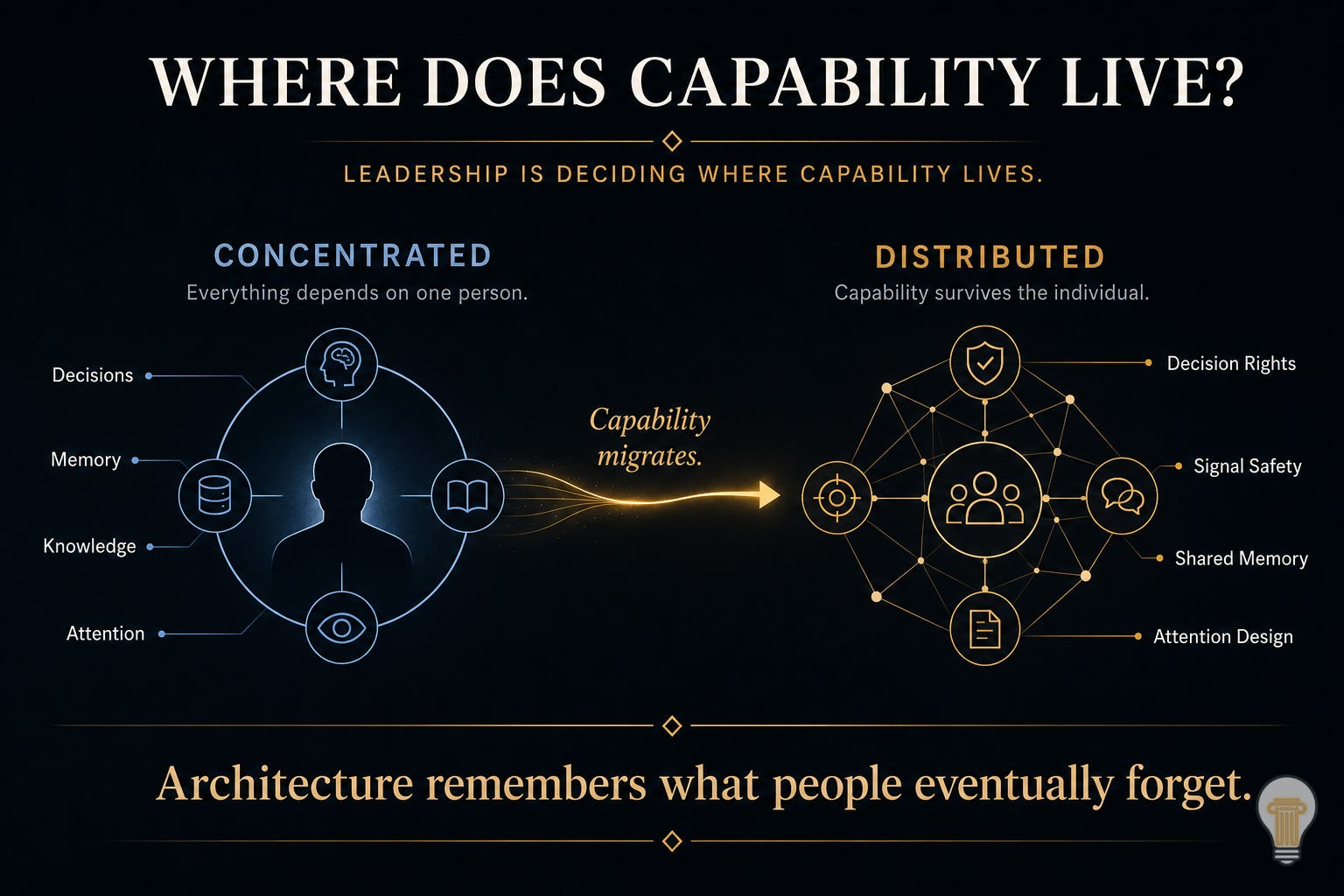
Slowly, almost invisibly, capability migrates.
Not into the team.
Into you.
You become:
The approval pathway.
The institutional memory.
The exception handler.
The quality control mechanism.
The emotional shock absorber.
The organisation no longer runs on shared judgement.
It runs on your continued availability.
Many leaders mistake this for effectiveness.
But it’s more dangerous than that.
It’s concentration risk.
Where does capability live?
Every leader answers this question, whether they realise it or not.
Most answer it without thinking.
Capability lives inside people.
Hire better people.
Train them better.
Develop stronger leaders.
Build more resilient teams.
None of that is wrong.
It’s just incomplete.
Capability has a location.
Sometimes it lives inside individuals.
Sometimes it lives inside the environment.
The difference explains why some organisations become stronger as they grow while others become increasingly dependent on a handful of exhausted experts.
Immature organisations store capability inside people.
Mature organisations progressively relocate capability into systems.
Not because people matter less.
Because people are finite.
They become tired.
They forget.
They resign.
They retire.
The environment remembers.
A decision framework remembers.
A playbook remembers.
A well-designed workflow remembers.
A culture built on clear incentives remembers.
The real work of leadership is relocating capability.
That’s our transition into Phase Three.
Until now, ARCHITECT has focused on strengthening the individual.
From here onward, it asks a different question.
Where should capability live so that good judgement survives your absence?
That’s what Environment Architecture is designed to answer.
Behaviour is never just about people
When teams hesitate, leaders often blame the people.
They lack initiative.
They avoid responsibility.
They need more confidence.
Sometimes that’s true.
More often, behaviour is responding exactly as the environment has taught it to.
Nearly ninety years ago, psychologist Kurt Lewin proposed an almost deceptively simple idea, that behaviour is a function of both the person and their environment (Lewin, 1936).
Modern leadership theory has largely remembered only the first half of that equation.
We’ve built entire industries around improving people.
Training.
Coaching.
Performance management.
Resilience.
Mindset.
The second half receives far less attention.
The environment itself.
The workflows.
The approval chains.
The meeting culture.
The incentives.
The information architecture.
The countless invisible conditions that quietly shape behaviour long before character gets a chance.
This changes the diagnosis.
When a capable team constantly waits for permission, perhaps the question isn’t,
“Why won’t they take ownership?”
Perhaps it’s,
“What have we designed that makes waiting the safest option?”
That question is a lot less comfortable.
It also happens to be far more useful.
Every environment teaches
Leaders often talk about culture as though it were a belief.
I think culture is better understood as accumulated evidence.
Despite the best efforts of executives, people don’t learn primarily from values statements.
They learn from repeated experience.
Who gets promoted.
Who gets interrupted.
Which meetings matter.
Which meetings quietly disappear.
Who receives credit.
Who gets blamed.
What happens after mistakes.
Where attention flows.
Every day the organisation teaches people how it really works.
Eventually those observations become habits.
Those habits become expectations.
Those expectations become culture.
Culture is not what the organisation says.
Culture is what the environment repeatedly proves.
That’s why incentives matter so much.
Every repeated behaviour survives because something in the environment rewards it.
Sometimes the reward is money.
More often it is approval.
Reduced risk.
Avoiding conflict.
Finishing the day with fewer difficult conversations.
Change the incentives and behaviour follows.
Leave the incentives untouched and culture will politely ignore your strategy.
Environment Architecture
Environment Architecture is the deliberate transfer of capability from individuals to environments.
That’s the work.
Not making yourself more indispensable.
Making the environment more capable.
Stoicism begins with a simple responsibility.
Govern yourself.
Govern your attention.
Govern your judgement.
Govern your character.
Leadership introduces a second dimension to that responsibility.
Govern the conditions that govern everyone else.
The meetings your team attends.
The decisions they are trusted to make.
The information they receive.
The incentives they experience.
The defaults they inherit.
The behaviours they watch being rewarded.
A resilient individual can withstand pressure.
A resilient environment distributes it.
The measure of leadership is no longer how much you personally carry.
It’s how little the organisation depends on you carrying it.
From personal resilience to institutional resilience
This is the inflection point in the ARCHITECT framework.
Phase One asked:
Can you govern yourself?
Phase Two asked:
Can you navigate uncertainty without surrendering your principles?
Phase Three asks something harder.
Can you build an environment that continues producing good judgement when you are no longer present?
That’s a fundamentally different challenge.
The measure of success is no longer your own performance.
It’s the capability of the environment you’ve designed.
Leadership therefore stops being about carrying the organisation.
It becomes about ensuring the organisation no longer needs to be carried.
This is where many experienced leaders become trapped.
They continue measuring themselves by personal resilience.
How many crises they can absorb.
How many difficult conversations they can hold.
How many decisions they can personally make before the day ends.
The organisation applauds.
Their team admires them.
Their calendar fills.
Their exhaustion deepens.
Meanwhile the system becomes progressively weaker because every difficult decision has taught the organisation the same lesson.
“Wait for the leader.”
The leader grows stronger.
The environment grows more fragile.
That’s not maturity.
It’s the opposite.
The highest form of resilience is designing systems that no longer depend on your resilience.
The Four Conditions of Architectural Leadership
Environment Architecture doesn’t require extraordinary charisma.
It requires deliberate design.
Capability moves gradually from individuals into the environment through four conditions.
1. Decision rights
Capability moves when decisions move.
Every unnecessary approval is a signal that ownership has not been designed.
People cannot act confidently if they never know where authority begins and ends.
Define clear decision thresholds.
Which decisions belong to the team?
Which require consultation?
Which genuinely require escalation?
When people understand the boundaries, ownership becomes architecture rather than personality.
2. Signal safety
Bad news is only expensive when the environment teaches people to hide it.
Amy Edmondson’s research on psychological safety found that high-performing teams create environments where uncertainty, mistakes and concerns surface early because people aren’t punished for speaking honestly (Edmondson, 1999).
Psychological safety is therefore not organisational kindness.
It is operational infrastructure.
Small problems become catastrophic only after an environment teaches people that silence is safer than truth.
3. Shared memory
Knowledge trapped inside one person is not organisational capability.
If you disappeared tomorrow, what knowledge would disappear with you?
Daniel Wegner described high-performing teams as developing transactive memory, where people know not only information but where that information lives (Wegner, 1987).
Document decisions.
Capture heuristics.
Record assumptions.
Build playbooks.
Documentation isn’t just administration.
It’s the organisation learning to remember.
4. Attention defaults
Every calendar is an operating system.
Most organisations claim they value thoughtful work.
Then they design environments optimised for interruption.
Back-to-back meetings.
Constant notifications.
Immediate responses.
Always-on communication.
People eventually optimise for responsiveness instead of judgement.
Visibility instead of value.
Activity instead of progress.
Attention is never only personal.
It’s also environmental.
If you want better thinking, redesign the environment that competes for it.
Architecture is invisible
Good architecture is easy to miss.
Nobody walks into a well-designed building and whispers thanks to the engineer every morning.
The building simply works.
Leadership should feel similar.
When Environment Architecture succeeds, people often attribute the results to culture.
Or good hiring.
Or luck.
What they are usually experiencing is something less visible.
Clear ownership.
Safe communication.
Shared knowledge.
Protected attention.
Healthy incentives.
Over time those conditions begin producing behaviours that once required extraordinary leaders.
The organisation appears calmer.
Decisions become faster.
New staff contribute earlier.
Problems surface sooner.
The leader becomes less busy.
Paradoxically, this is often interpreted as the leader becoming less important.
However, the opposite is true.
Their capability has simply moved.
It no longer rests on them.
It has become part of the environment.
The Absence Test
Every leader eventually leaves the room.
For an afternoon.
For a conference.
For annual leave.
For another role.
For retirement.
The question is not whether that day will come.
The question is what happens when it does.
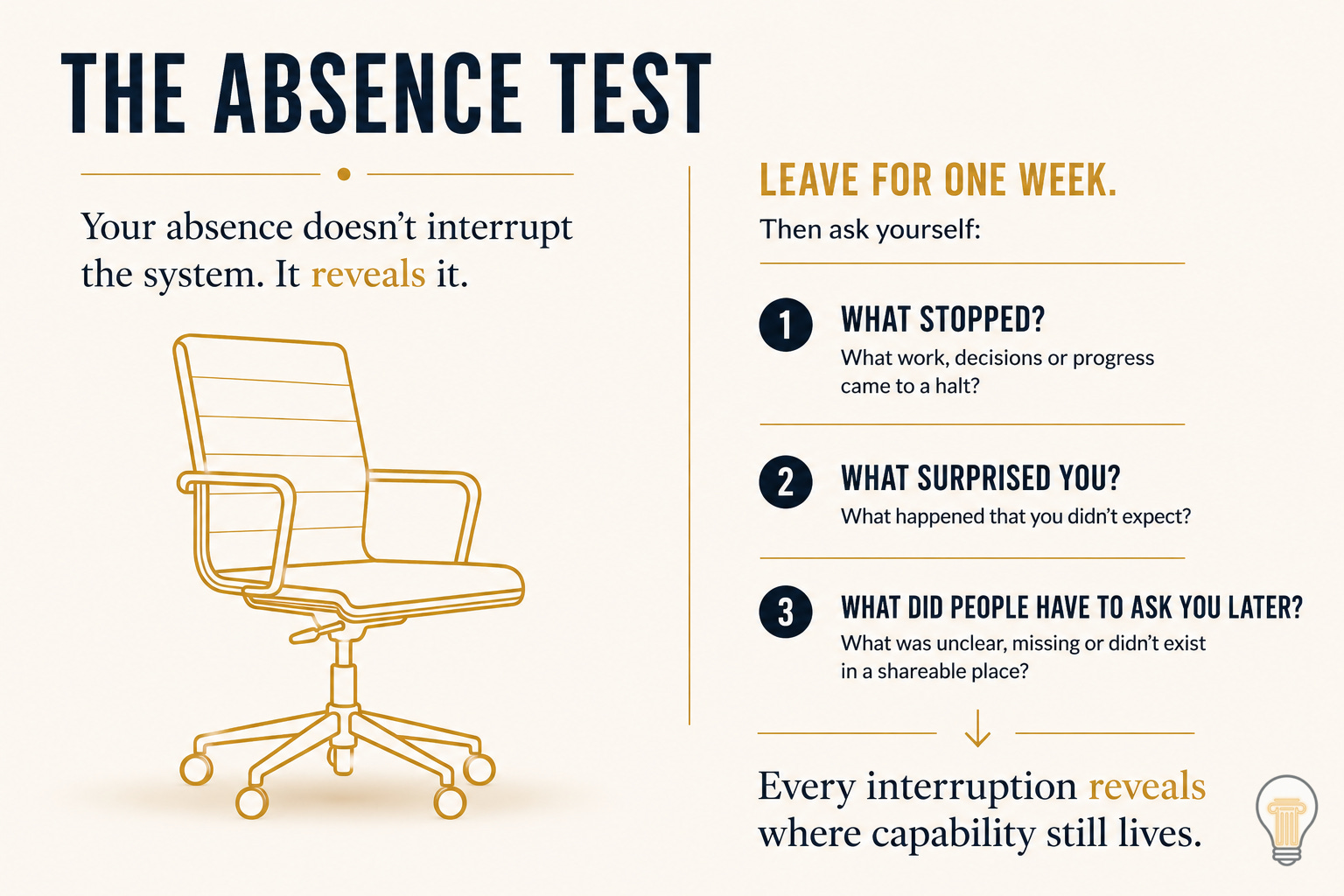
Does work continue?
Do decisions keep moving?
Do problems surface early?
Does the environment remember what matters?
Or does capability quietly leave with the person?
Your absence is not the interruption.
It’s the audit.
It reveals where capability still lives.
Every stalled decision points to unclear ownership.
Every repeated question points to an undocumented principle.
Every unnecessary escalation points to capability that has never been transferred into the environment.
The system is telling you exactly where it remains fragile.
Your task is not to work harder.
It’s to redesign those conditions.
Architecture before motivation
When teams struggle, leaders often reach first for motivation.
Another speech.
Another workshop.
Another conversation about ownership.
Sometimes that helps.
Often it doesn’t.
People rarely need another reminder to care.
They do need an environment that allows caring to produce better outcomes.
The temptation is to treat every organisational problem as a people problem.
The deeper discipline is asking whether it is really a design problem.
This does not remove personal responsibility.
Character still matters.
Judgement still matters.
Capability still matters.
Environment Architecture assumes all of that.
It just recognises another truth, that even excellent people eventually lose against poorly designed systems.
The most effective leaders don’t spend their careers asking people to overcome broken environments.
They steadily remove the reasons those environments keep producing the same predictable failures.
That’s why this pillar proceeds Timeless Core.
Principles tell us what matters.
Architecture determines whether those principles survive contact with everyday work.
Monday morning
Don’t try to redesign your entire department.
Architects don’t begin by rebuilding the city.
They begin by identifying one structural weakness.
Start there.
Think about the question your team asks you most often.
Not the difficult strategic question.
The repetitive one.
The request that lands on your desk every Tuesday.
The issue everyone believes only you can decide.
Now ask yourself a hard question.
Why?
Why does this decision keep returning to you?
Is it genuinely high risk?
Or has the environment simply never taught anyone another way?
Write a one-page heuristic.
Not a policy.
A heuristic.
A practical rule of thumb.
Describe:
when the decision belongs to the team
the principle behind it
where the boundaries sit
when escalation becomes necessary
how the decision should be recorded
Publish it.
Talk about it.
Then do something that will probably feel uncomfortable.
Stop answering that particular question.
Not because you no longer care.
Because the system needs to learn.
Every time you ride on in to take the decision back, you reinforce the architecture you’re trying to replace.
Every time the team successfully applies the heuristic without you, capability moves.
Not dramatically.
Not all at once.
Incrementally.
From the individual...
...into the environment.
That’s where organisational resilience begins.
The ARCHITECT shift
The first six pillars asked Alex to become more capable.
Protect attention.
Choose leverage.
Preserve the friction that builds judgement.
Build calm consistency.
Think beyond the immediate horizon.
Anchor decisions in enduring principles.
Those disciplines remain essential.
They always will.
But if capability remains trapped inside one exceptional individual, the organisation remains fragile.
Phase Three asks a different question.
Where should capability live?
The answer cannot simply be:
“Inside me.”
It must gradually become:
“Inside the environment we’re building.”
That’s the transition from self-improvement to stewardship.
From personal excellence to institutional capability.
From heroic leadership to architectural leadership.
Environment Architecture
The first six pillars taught Alex to become more capable.
This pillar asks Alex to become less necessary.
Not less valuable.
Less necessary.
There is an important difference.
Organisations built around extraordinary individuals eventually inherit their limits.
Organisations built around extraordinary environments allow ordinary people to achieve remarkable consistency.
That’s the beginning of institutional resilience.
It’s also the beginning of stewardship.
Leadership is no longer measured by how much capability you possess.
It’s measured by how much capability remains after you have gone.
That is the work of the architect.
Next: Constructive Detachment
Really enjoyed this perspective. Great leadership is about building systems, not becoming the system
The core diagnosis is right: a capability that lives in only one person is a liability wearing a compliment. The 417-email audit is a sharp opener.
Where I'd push back is that the framework treats "stop answering that question" as mostly a design choice. In my experience, it's also a matter of trust. Leaders don't hoard decisions because the system lacks a heuristic; they hoard them because the first time they let go, something went wrong, and they never forgave the system for it. Architecture without that reckoning just produces a nicer-looking bottleneck.
The other gap: nothing here on what the leader does with the capacity they free up. Relocating capability into the org is necessary but not sufficient if the leader just fills the space with more meetings; you've built a better system carrying the same exhausted person.
Good structural thinking. Missing the emotional mechanics of why leaders actually cling.