
Heroics Are a Sign the System Failed
Calm Consistency — Part 3 of ARCHITECT: How stable systems beat bursts of intensity

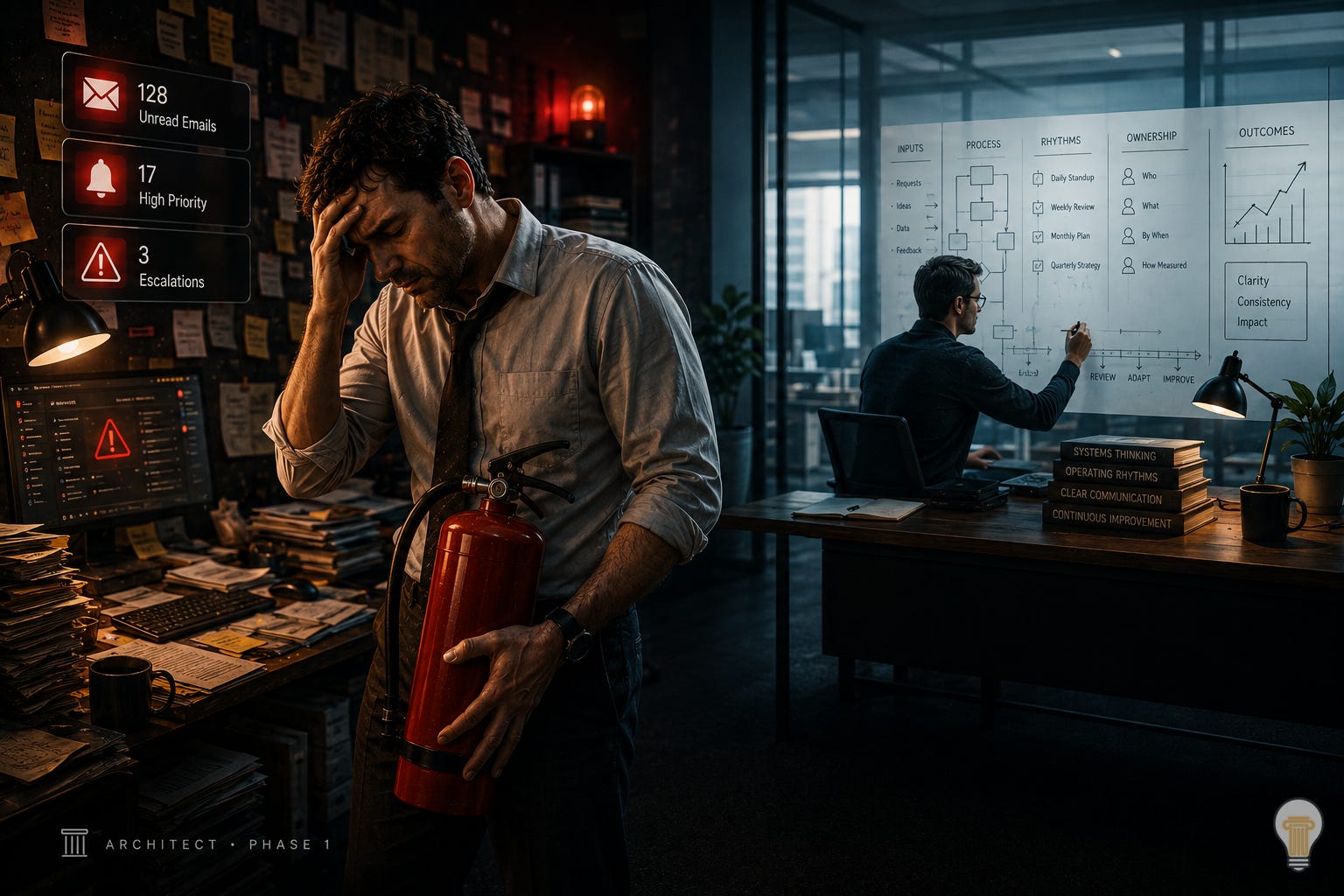
The rescue everyone applauded
Friday afternoon.
A routine board report is late.
Two managers cancel dinner plans. A coordinator stays online past 11:00 PM. Someone manually reconciles conflicting spreadsheets while another rewrites the executive summary under pressure.
By Monday morning, the report is submitted.
The director gets praised.
“Great save.”
Nobody asks the better question:
Why did routine work require a rescue?
This happens everywhere.
The team that pulls an all-nighter to hit an artificial deadline gets celebrated.
The manager who absorbs operational chaos without complaint gets labelled “dependable.”
The department running permanently on adrenaline gets mistaken for high performance.
But the praise hides the real problem.
If ordinary work keeps requiring extraordinary effort, the system is already failing.
The heroic rescue loop
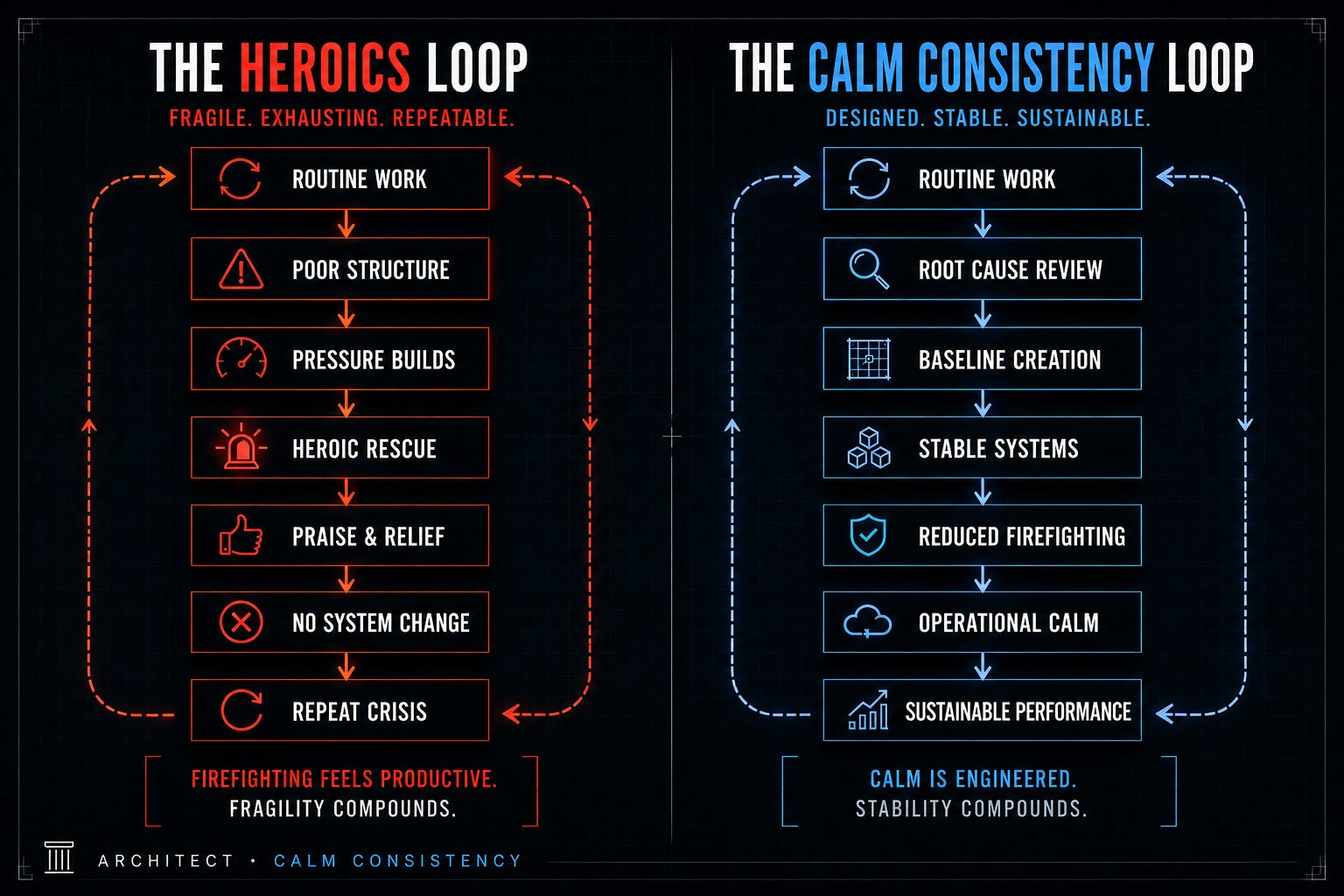
Most organisations accidentally reward firefighting.
The pattern is predictable:
routine work is poorly structured
pressure accumulates silently
competent people compensate manually
the crisis gets resolved at the last minute
everyone moves on
nothing upstream changes
Then the cycle repeats.
Researchers Nelson Repenning and John Sterman described this dynamic as organisational “firefighting”: the repeated diversion of attention and resources toward urgent problems discovered too late in the process (Repenning and Sterman, 2001).
The dangerous part is that firefighting often feels productive.
People are busy.
Energy is high.
Urgency creates emotional significance.
But firefighting creates hidden debt.
Every rescue prevents the organisation from confronting the system that caused the failure in the first place.
The praise feels good.
The system learns nothing.
Adrenaline is not an operating model
Short bursts of pressure are survivable.
Chronic pressure is corrosive.
The World Health Organization defines burnout as an occupational phenomenon resulting from chronic workplace stress that has not been successfully managed (World Health Organization, 2019).
Not occasional stress.
Chronic stress.
That distinction is important.
A well-designed system can survive moments of intensity.
A poorly designed system depends on them.
This is where many mid-career professionals become trapped.
They build an identity around being the ‘reliable rescuer’:
the person who absorbs the chaos
the person who always steps in
the person who keeps the system functioning through personal sacrifice
At first, this feels meaningful.
But, eventually, it becomes unsustainable.
Adrenaline can carry a crisis.
It cannot carry a thirty-year career.
Calm Consistency
This is where our third pillar begins.
‘Calm Consistency’ is the discipline of converting recurring work into reliable baselines, so performance doesn’t depend on mood, panic, or heroics.
It is not:
low ambition
passivity
bureaucracy
emotional detachment
It is operational maturity.
Calm Consistency means:
fixed rhythms
repeatable standards
predictable communication
clear ownership
stable handoffs
systems that still function on difficult days
Most people think calm is emotional.
It isn’t.
Calm is structural.
A calm team is usually a team whose systems no longer require constant improvisation.
Excellence is more boring than we admit
We are conditioned to associate excellence with dramatic effort.
But research suggests the opposite.
In The Mundanity of Excellence, sociologist Daniel Chambliss studied Olympic swimmers and found that elite performance was not built through constant heroic intensity. It emerged from small, repeated behaviours executed consistently over long periods of time (Chambliss, 1989).
Excellence looked fairly ordinary up close.
The best performers were not constantly chasing inspiration.
They had stable routines.
Stable preparation.
Stable standards.
The same is true inside organisations.
Professional excellence rarely looks cinematic.
It looks like:
meetings that begin prepared
projects that do not become emergencies
reports that do not require midnight rescues
systems that keep functioning under pressure
The irony is brutal.
The calmer the operation becomes, the less visible the competence behind it appears.
If it happens twice, build a baseline
Most leaders treat recurring problems as isolated events.
They aren’t.
If the same issue appears repeatedly, you do not have a people problem.
You’ve got a baseline problem.
A baseline is simply operational memory.
It can be:
a checklist
a template
a communication rhythm
a triage rule
a documented process
a decision framework
a recurring review
The point is not to bureaucratise everything.
It’s to stop wasting cognitive energy, time and money on preventable chaos.
This is why elite professions rely so heavily on checklists.
In high-stakes environments like aviation and surgery, professionals do not rely purely on memory or inspiration. They use structured protocols because pressure degrades cognition.
Atul Gawande popularised this idea in The Checklist Manifesto, drawing partly on research showing that surgical safety checklists significantly reduced complications and deaths across multiple hospitals (Gawande, 2009; Haynes et al., 2009).
The lesson is not:
→ “Checklists are good.”
The lesson is deeper:
→ Competent professionals understand that reliability matters more than heroics.
A checklist is not an insult to expertise.
It’s respect for human limitation.
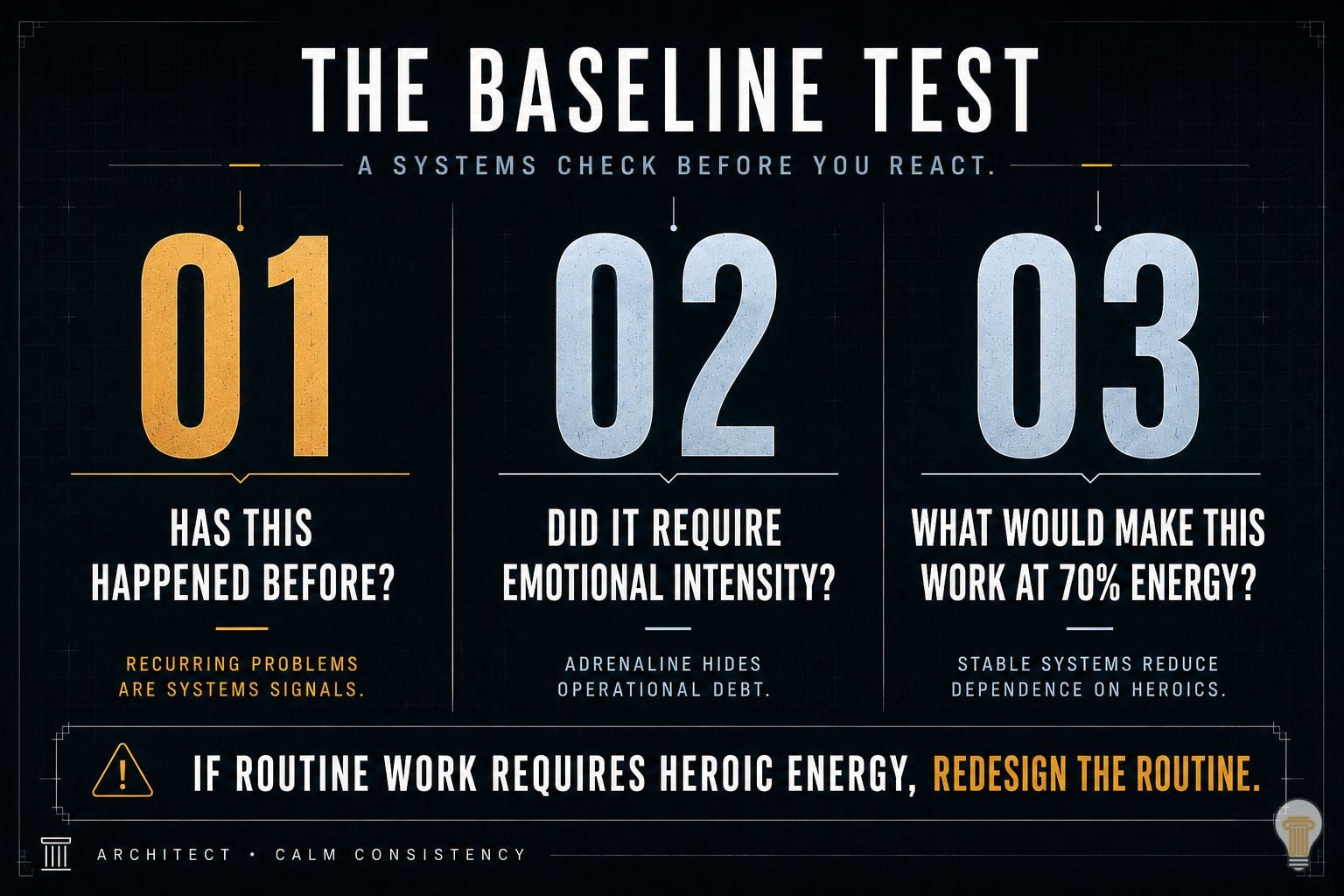
The Baseline Test
Before accepting recurring chaos as normal, ask:
1. Has this happened before?
If yes, stop calling it exceptional or unprecedented.
2. Did it require emotional intensity to complete?
If yes, the process is carrying hidden operational debt.
3. What would make this run successfully at 70% energy?
That’s the baseline you need to build.
Most systems are designed accidentally.
Calm Consistency is what happens when you start designing them deliberately.
What this looks like in practice
The communication baseline
Stop rewriting stakeholder updates from scratch every week.
Create a stable reporting rhythm:
What changed
What matters
What’s blocked
What decision is needed
What happens next
Reliable communication beats inspired communication.
The triage protocol
Stop treating every inbound request as equally urgent.
Classify requests by:
consequence
reversibility
deadline
ownership
escalation threshold
Urgency without structure becomes organisational anxiety.
The meeting baseline
No agenda. No decision. No meeting.
Harsh?
Maybe.
But endless meetings are often a symptom of unresolved ambiguity upstream.
The rescue review
Every heroic rescue should trigger a post-mortem.
Ask:
What failed upstream?
What signal was missed?
What baseline would prevent recurrence?
Do not just celebrate the rescue.
Study why it was necessary.
Rewarding the right behaviour
Stop disproportionately praising the staff member who works until midnight to save the project.
Start praising the employee whose systems are so stable that nothing catches fire in the first place.
That’s the person quietly protecting the organisation from entropy.
The deeper shift
Most professionals spend years trying to become more resilient.
Often, what they actually need is a more stable operating environment.
Resilience matters.
But resilience without system design becomes glorified endurance.
Calm Consistency isn’t about lowering standards.
Rather, it’s about making high standards sustainable.
The best-run systems rarely look heroic.
They just keep working and creating value.
The mandate
Look at the last seven days.
Find one moment where routine work required heroic effort.
Do not praise it yet.
Study it.
Then build the boring thing that prevents it from happening again:
the checklist
the template
the review rhythm
the ownership rule
the communication standard
Stability isn’t laziness, as though you lack hustle.
No. It’s accumulated operational intelligence.
Continue the series
Phase 1 was about reclaiming control over your immediate operating environment:
defending attention
choosing work that compounds
protecting judgement
building stable systems
Now comes the harder shift.
Once the daily operating system stops consuming your nervous system, you finally gain the capacity to look up.
That’s where Phase 2 begins.
Next: Horizon Thinking
Why serious leaders build for futures they may never personally benefit from.
Start here: The Cognitive Firewall
This should be required reading for every leader in tech.
When organizations praise the rescue but ignore the root cause, they quietly train people to repeat the same crisis.