
The System Must Give Something Back
True Renewal — Part 9 of ARCHITECT: How to restore the capacity the work consumes

The crisis lasted eleven days.
The pace lasted six months.
The deadline had been real.
A critical system had failed.
Customers were waiting.
Staff volunteered for extra shifts.
Meetings multiplied.
Weekends disappeared.
Normal priorities were suspended.
Nobody complained.
The team delivered.
Everyone celebrated.
Then Monday arrived.
The daily crisis meeting remained.
The weekend emails continued.
The extra reporting stayed.
The urgency never left.
The organisation solved the crisis.
It institutionalised the emergency.
Nobody had decided this.
It just… happened.
Every temporary accommodation became permanent.
Every exception became expectation.
Every act of extraordinary effort quietly redefined what “normal” looked like.
Six months later the team still looked productive.
Projects continued moving.
Targets were being met.
The system appeared healthy.
It wasn’t.
It was consuming capability faster than it restored it.
Healthy systems restore what they consume.
That’s the simplest definition of renewal.
Most organisations know how to accelerate.
Very few know how to decelerate.
They know how to:
Launch the project.
Mobilise the taskforce.
Respond to the crisis.
Meet the deadline.
Push through the quarter.
What they rarely know how to do is stop.
Intensity becomes habit.
Habit becomes culture.
Culture becomes architecture.
Eventually nobody remembers why the emergency routines still exist.
They just… inherit them.
The team survived the crisis.
The crisis became the system.

The final transition
ARCHITECT began with a simple observation.
The modern workplace asks us to think clearly under conditions that make clear thinking increasingly difficult.
Each pillar has addressed one part of that problem.
Protect your attention.
Preserve useful friction.
Choose leverage instead of busyness.
Act consistently.
Look beyond immediate demands.
Anchor yourself in enduring principles.
Build environments that distribute capability.
Hold your strategies lightly enough to revise them.
The final pillar asks a different question.
After all of that...
Who restores the capability the work has consumed?
Because every meeting costs attention.
Every difficult decision costs judgement.
Every crisis costs emotional reserve.
Every responsibility extracts something.
The mistake is assuming capability behaves like software.
That, once installed, it remains available forever.
It doesn’t.
Capability behaves more like a living system.
Living systems obey a different logic.
Forests do not survive because they never lose leaves.
Muscles do not grow because they are never stressed.
Neither becomes stronger by avoiding expenditure.
They survive because loss is followed by renewal.
Organisations are no different.
They must continually be renewed.
The Permanent Surge
There is a hidden failure mode in many successful organisations.
I think of it as the Permanent Surge.
A surge is healthy.
Sometimes necessary.
Hospitals experience surges.
Emergency services experience surges.
Universities experience enrolment surges.
Businesses experience product launches, restructures and cyber incidents.
The problem isn’t the surge.
The problem is forgetting to end it.
Temporary intensity easily becomes the operating system.
Every week begins feeling like deadline week.
Every email feels urgent.
Every interruption feels justified.
The organisation becomes remarkably good at operating in crisis.
And progressively worse at everything else.
The irony is… uncomfortable.
People often describe these workplaces as resilient.
They aren’t.
They’re enduring.
Those are two very different things.
Endurance keeps producing while capability declines.
Renewal restores capability before decline becomes normal.
That distinction matters more today than ever.
Because the scarce resource in modern work is no longer execution.
Increasingly, it is judgement.
Endurance is not renewal
Most discussions about burnout begin in the wrong place.
They begin with the individual.
Sleep more.
Take a holiday.
Exercise regularly.
Switch off your notifications.
None of that is bad advice.
It is just incomplete.
Burnout is often described as a personal failure to recover.
More often, it is a systemic failure to restore.
That distinction is important.
Because an exhausted leader can still produce.
They can still attend meetings.
Still answer emails.
Still approve budgets.
Still meet deadlines.
Output often survives long after judgement falls into decline.
That makes depletion difficult to recognise.
The dashboard still looks healthy.
The calendar remains full.
The work keeps moving.
All while capability is slowly eroding underneath it all.
This is one of the central paradoxes of modern leadership.
We assume continued performance proves continued capacity.
In reality, it often proves only that someone is spending tomorrow’s capability to meet today’s commitments.
Endurance is expensive.
The invoice simply arrives later.
Judgement is biological
The AI era has changed the economics of knowledge work.
Execution is becoming cheaper.
Drafting.
Summarising.
Searching.
Analysing.
Many forms of cognitive production that once consumed hours now consume minutes.
The bottleneck has moved.
Not just towards producing more.
Towards deciding what deserves to be produced.
Judgement is increasingly becoming the scarce resource.
That means the human bottleneck is increasingly biological rather than technological.
You cannot automate depleted judgement.
That sounds like an intellectual challenge.
But it’s mostly a biological one.
Research consistently shows that restricted sleep impairs several of the very capabilities leaders depend upon most, including executive functioning, attention and cognitive flexibility (Lowe, Safati and Hall, 2017).
Under sustained stress we become more reactive.
More habitual.
Less able to hold competing possibilities in mind.
Exactly the opposite of what Constructive Detachment asked us to cultivate.
Notice what this means.
The final threat to good judgement is not always poor character.
Sometimes it is chronic depletion.
A tired leader does not just have less energy.
They have fewer options available to their thinking.
That’s important because organisations rarely respond to depleted judgement by reducing demand.
They respond by demanding more execution.
The very response intended to recover performance further depletes the capacity required to restore it.
The system begins cannibalistically consuming the very resource it depends upon.
Leaders teach the tempo
Environment Architecture taught us that leaders design more than workflows.
They design conditions.
True Renewal extends that idea.
Leaders also set the tempo.
People pay surprisingly little attention to what leaders say about “balance”.
They pay extraordinary attention to what leaders repeatedly do.
An email sent late on Sunday evening.
A meeting scheduled across lunch because “it’s the only time everyone is free.”
Annual leave interrupted for routine approvals.
Quiet praise for the colleague who “always goes above and beyond.”
None of these behaviours seem significant in isolation.
Together they become instruction.
Research on emotional contagion suggests that leaders influence far more than task allocation. Their emotional state shapes the emotional tone of the groups they lead (Sy, Côté and Saavedra, 2005).
More recent research adds another layer.
When leaders consistently devalue sleep through their own behaviour and expectations, employees begin doing the same, with measurable consequences for wellbeing and conduct (Barnes et al., 2020).
Leaders do not just allocate work.
They teach the organisation what recovery is worth.
This is where True Renewal reconnects with Environment Architecture.
The environment is not only where work happens.
It’s where pressure spreads.
If urgency becomes the permanent emotional climate, the architecture is no longer distributing capability.
It’s steadily consuming it.
Otium
Modern organisations usually understand rest as the absence of work.
The Stoics understood something richer.
Seneca distinguished between negotium, the demands of public life, and otium, the deliberate withdrawal that allowed a person to recover perspective, cultivate character and prepare wisely for their return.
Otium wasn’t idleness.
Nor was it recovery in the modern corporate sense.
It was time intentionally reclaimed from the immediate claims of the world.
Time for reflection.
Study.
Conversation.
Nature.
Silence.
The point wasn’t to become more productive on Monday.
It was to remember that your identity extended beyond the office.
Constructive Detachment taught Alex that the strategy was not them.
True Renewal teaches something equally important.
That neither is the role.
The role is something you perform. It’s not someone you are.
That may be the hardest lesson in our entire framework.
Because organisations naturally encourage us to become increasingly identified with our usefulness.
Our calendars.
Our responsiveness.
Our indispensability.
Eventually we begin measuring our worth by our availability.
Seneca would have recognised this danger immediately.
A life entirely consumed by negotium eventually loses the perspective required to conduct it wisely.
Yes, you get worse at your job if you only focus on the job.
Withdrawal is not the opposite of responsibility.
Sometimes it is how responsibility is restored.
Capability is renewed in surprisingly ordinary places.
Unhurried conversations.
Long walks.
Time with children.
Reading without purpose.
Learning something unrelated to work.
Silence.
None of these activities appears productive.
Many are where perspective returns.
The Renewal Cadence
If renewal matters this much, we cannot leave it to chance.
We also cannot rely on willpower to make it happen.
That mistake should sound familiar by now.
ARCHITECT has repeatedly argued that important behaviours should not depend on motivation alone.
Attention needed a Cognitive Firewall.
Leverage needed Intentional Refusal.
Capability needed Environment Architecture.
Renewal deserves the same discipline.
It needs architecture.
I call it the Renewal Cadence.
Not because every leader needs the same routine.
But because healthy systems need recurring rhythms that restore what the work consumes.
Those rhythms exist at four different scales.
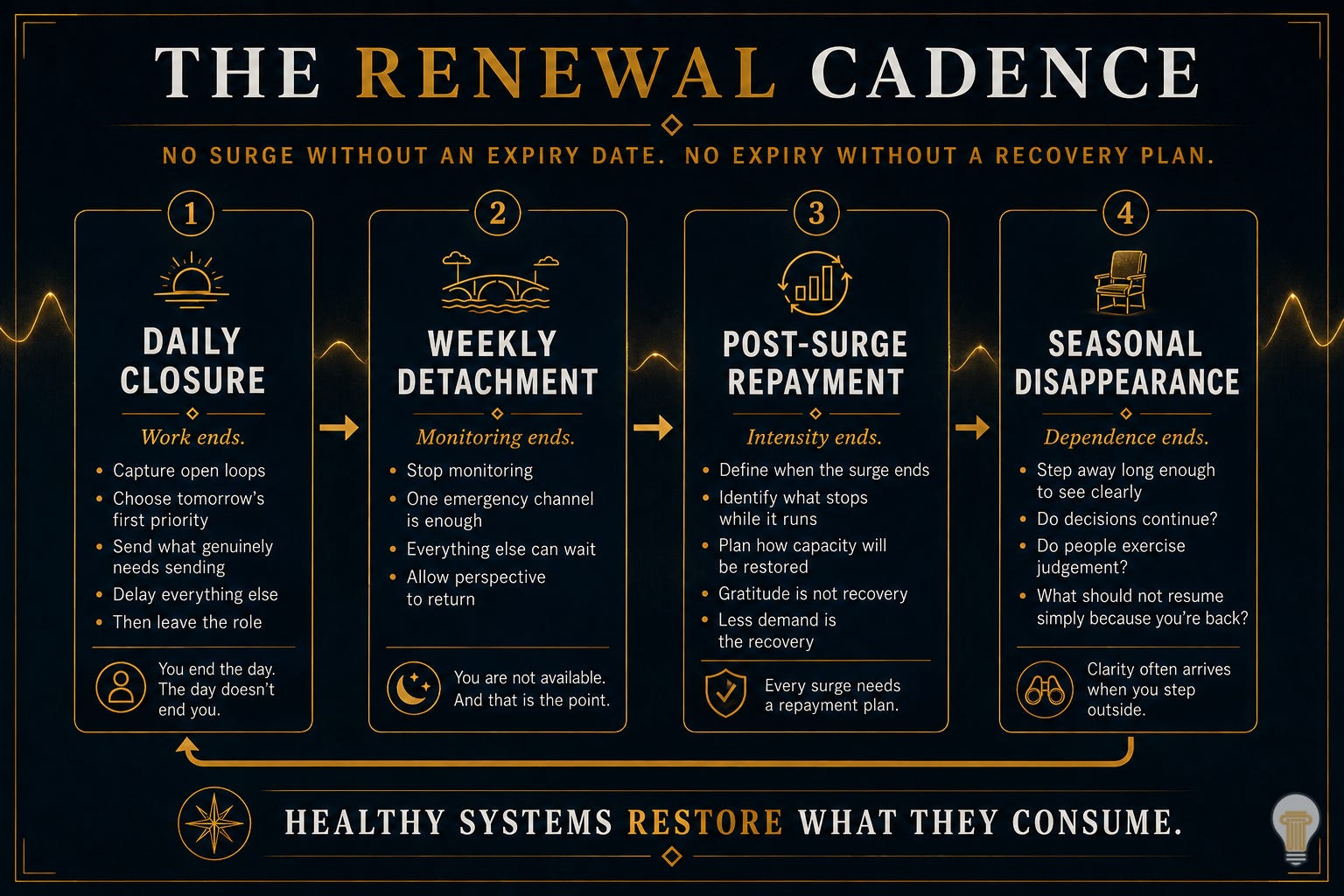
1. Daily closure
Every workday should have an ending.
Not just because the clock says so.
Because your mind often doesn’t realise the day has finished.
Unanswered emails.
Half-written documents.
Unresolved conversations.
They remain cognitively active long after the laptop closes.
A deliberate daily closure helps complete the day.
Capture the open loops.
Choose tomorrow’s first priority.
Send what genuinely needs sending.
Delay everything else.
Then leave the role.
Not because the work is finished.
Because you are.
2. Weekly detachment
Many people stop working on weekends.
Far fewer stop monitoring.
There is an important difference here.
If you spend Saturday checking Slack or Teams, you have not detached from work.
You have just postponed responding.
Renewal requires periods when the organisation is allowed to continue without your supervision.
One emergency channel is enough.
Everything else can wait.
The objective is to allow your mind to become unavailable to routine demands.
Only then can perspective return.
3. Post-surge repayment
Every genuine surge should contain its own recovery plan.
Before the work intensifies, decide three things.
When does the surge end?
What normal work stops while it runs?
How will capacity be restored afterwards?
Without those answers, organisations rarely return to normal.
They’re just normalising exhaustion.
The team receives a thank-you email.
Perhaps a morning tea.
Then another impossible deadline.
Gratitude is not recovery.
Recovery requires less demand.
4. Seasonal disappearance
Annual leave is not just time away.
It’s a systems audit.
When you disappear for two weeks, the organisation reveals where capability still lives.
Do decisions continue?
Do people exercise judgement?
Do problems surface without you?
Or does everything quietly accumulate until your return?
Environment Architecture asked whether the system could function without you.
True Renewal asks whether you can disappear long enough for the answer to become clear.
Then, before returning, ask a final question.
What should not resume simply because I’m back?
That question completes Constructive Detachment.
Sometimes the clearest view of a system comes from stepping outside it.
Closing the circuit
ARCHITECT began with attention.
Because attention is where judgement begins.
It finishes with renewal.
Because renewal is how judgement survives.
Along the way, Alex learned to protect attention rather than surrender it.
To preserve the friction that builds capability.
To choose leverage over activity.
To act consistently instead of dramatically.
To think beyond the immediate horizon.
To anchor decisions in enduring principles.
To build systems that distribute capability.
To hold strategies lightly enough to revise them.
The final lesson is the simplest one.
Capability is not an asset you possess.
It’s a living resource.
Every living resource must be renewed. It can be:
Strengthened.
Distributed.
Protected.
Consumed.
And renewed.
That’s why resilient organisations look different from mere busy ones.
They do not just absorb pressure.
They recover from it.
They do not demand capability.
They restore it.
ARCHITECT was never about becoming indispensable.
It was about becoming dependable.
Not because you can or should endure endless pressure.
Because you could preserve capability as you move through it.
That requires attention worth defending.
Judgement worth protecting.
Systems worth building.
Lives worth living beyond the work itself.
A resilient system is not a buffer to absorb pressure.
It restores what pressure consumes.
The future will continue asking more of us.
The question is no longer whether we can keep giving.
It’s whether we have built lives that know how to restore what’s been given away.
The system must give something back.
We spend so much time asking, “What am I getting done?” and not enough asking, “What is this way of working doing to me?”
I've learned that a system can be extremely efficient and still be badly designed if it consistently leaves you depleted.
For me, that is the real test of sustainable productivity: the system should not only produce outcomes. It should return something to the person operating it: clarity, energy, confidence, or simply enough headspace to begin again tomorrow.
If the system only takes, eventually the human becomes the bottleneck.
Such a useful concept. We’re usually very good at planning for the extra workload, but rarely account for the capacity it consumes. A major budget cycle, transformation or crisis should come with a recovery plan just as deliberately as it comes with a resource plan. Great post!