
The Work Was Never the Capability
When competent work becomes commonplace, the real challenge isn't producing it. It's recognising the capability behind it.

For centuries, good work usually told us something true about the person who produced it.
Not everything.
Something.
A thoughtful report suggested thoughtful preparation.
Clear writing suggested clear thinking.
Sound judgement suggested someone capable of exercising it again.
The relationship was never perfect.
It didn’t need to be.
It only needed to be reliable enough.
I’m no longer sure that’s true.
Not because people have become less capable.
Because capability has always been invisible.
The work was simply how we went about recognising it.

We Never Saw Capability
We never observe judgement directly.
Or wisdom.
Or creativity.
Or integrity.
We recognise them through what people do.
A difficult conversation handled well.
A decision made with incomplete information.
A piece of writing that clarifies rather than obscures.
The visible work tells us something about the invisible person behind it.
Professional life has subtly depended on that relationship for centuries.
Universities assess it.
Employers recruit through it.
Clients buy it.
Colleagues trust it.
Entire careers are built upon it.
We often say organisations reward capability in people.
Not quite.
They reward the evidence of it they can recognise.
Most of the time those are the same thing.
Capability produces convincing evidence of itself in the form of work outputs.
That’s why we rarely notice the distinction between capable people and what they produce.
Until something changes.
Every system eventually becomes a system for producing what it rewards.
That isn’t a problem while that capability evidence remains reliable.
Until it isn’t.
Looking back, AI didn’t create this problem.
It exposed it.
We’ve mistaken evidence of capability for capability itself.
That mistake has always been there.
The evidence was just consistently reliable enough that we didn’t notice.
The Floor Is Rising
Generative AI is remarkably good at raising the floor.
It would be surprising if it weren’t.
Every important technology raises the baseline for something.
Printing raised the baseline for access to knowledge.
Search engines raised the baseline for finding information.
Generative AI is raising the baseline for knowledge work.
Research increasingly points in the same direction.
Professionals using generative AI complete many writing and communication tasks faster while producing higher quality work. The largest improvements tend to occur among less experienced workers, narrowing the gap between novice and expert performance (Noy and Zhang, 2023; Brynjolfsson, Li and Raymond, 2023).
That’s worth celebrating.
Knowledge work has always contained unnecessary barriers.
People with valuable ideas have often struggled to express them.
Routine drafting has consumed hours that could have been spent improving the thinking behind it.
Removing those barriers is progress.
The mistake is assuming the work now tells us what it used to.
Writing makes the shift unusually easy to see.
For most of my career, reading someone’s work gave me a reasonable sense of how they thought.
A confused argument usually reflected confused thinking.
A carefully structured paper usually reflected someone who had wrestled with the problem before arriving at a conclusion.
Now I hesitate.
An excellent first draft no longer tells me what it once did.
Am I reading the work of an exceptional writer?
Someone who collaborated exceptionally well with AI?
Or someone who accepted a persuasive answer they lacked the experience to question?
Increasingly, it’s harder to tell.
That uncertainty reaches far beyond writing.
It touches every profession built on judgement rather than routine.
For years we’ve argued about whether AI will replace experts.
The more compelling question is whether we’ve misunderstood expertise.
Perhaps expertise was never the ability to produce competent work.
Perhaps competent work was simply one of the ways expertise revealed itself.
The research hints at that distinction.
When researchers studied more than 5,000 customer support agents using a generative AI assistant, the greatest improvements occurred among novice workers rather than experienced ones (Brynjolfsson, Li and Raymond, 2023).
That finding is usually interpreted as evidence that AI democratises expertise.
It certainly democratises performance.
Whether it democratises capability is another question.
Performance is what happened.
Capability is what remains when the conditions change.
That difference rarely matters while everything behaves as expected.
It matters enormously the moment it doesn’t.
Capability Reveals Itself at the Edges
Routine work rewards routine competence.
Capability reveals itself somewhere else.
At the edges.
When yesterday’s process no longer fits today’s problem.
When two reasonable priorities suddenly collide.
When the AI produces an answer that sounds convincing but isn’t.
When the familiar script stops working.
Performance tells us what happened.
Capability determines what happens next.
Changing conditions don’t create capability.
They reveal it.
That’s why organisations operating in high-risk environments pay such close attention to changing conditions.
High Reliability Organisations don’t judge themselves by how well they perform on an ordinary Tuesday. They pay close attention to how they respond as conditions begin to deteriorate.
Karl Weick and Kathleen Sutcliffe describe this as a preoccupation with failure. The objective isn’t pessimism. It’s recognising weak signals before they become major failures (Weick and Sutcliffe, 2015).
The same pattern appears in expert decision-making.
Gary Klein found that experienced firefighters, military commanders and emergency clinicians don’t simply analyse situations more effectively. They often perceive them differently. Years of experience allow them to recognise subtle patterns, detect anomalies and notice when a situation no longer fits the familiar script (Klein, 2017).
This principle also applies to people.
Character rarely distinguishes itself while life is easy.
Judgement rarely distinguishes itself while every decision is familiar.
Capability rarely distinguishes itself while every problem has already been solved.
We notice all three when the conditions change.
The floor has risen.
That’s an extraordinary achievement.
The person standing on it, however, may not have risen.
Which raises a different question.
If changing conditions reveal capability...
where does that capability come from?
The Ladder
If capability reveals itself when the conditions change, another question follows naturally.
Where does that capability come from?
We tend to admire expertise once it has fully formed.
We rarely notice how it formed.
An experienced clinician doesn’t consciously remember the thousands of ordinary consultations that shaped their judgement.
An accomplished writer rarely remembers the awkward drafts that taught them how to think on the page.
A good leader rarely remembers every difficult conversation that slowly changed how they listened.
We celebrate the ceiling.
We forget the ladder.
Expertise rarely arrives in moments of inspiration.
It accumulates.
One conversation.
One decision.
One mistake.
One revision.
Then another.
The work itself often feels forgettable.
Only later do we realise it was slowly evolving us.
Decades of research into expertise point in a similar direction.
Experts don’t simply accumulate more knowledge. They develop richer mental representations of their domain through repeated practice, timely feedback and reflection. Over time, those experiences reshape how they understand problems, not merely how much they know about them (Ericsson and Pool, 2016).
Capability isn’t built through information alone.
It’s built through experience meeting reflection.
This is where AI presents a more interesting challenge than mere productivity.
Some work deserves to disappear.
Nobody becomes wiser or more fulfilled by copying information between systems.
Few people develop better judgement because they spent another afternoon formatting slides.
Automation should remove that work without hesitation.
But other work only appears routine.
The first difficult client meeting.
The explanation that didn’t survive scrutiny.
The project that failed for reasons nobody anticipated.
The draft that revealed weaknesses in our own thinking before anyone else saw it.
Those experiences don’t just produce output.
They produce the person capable of better output later.
That’s a very different kind of work.
For years we’ve spoken about removing friction from work.
Mostly, that’s a good thing.
Bad systems deserve redesign.
Administrative waste deserves elimination.
Technology should remove pointless effort wherever it can.
But not every form of friction is waste.
Some friction is carrying the learning.
The question is no longer:
Can AI do this work?
The better question is:
What kind of capability does this work still develop?
That question changes almost everything.
Because once competent performance becomes easier to produce, the scarce resource moves again.
Not away from capability.
Towards developing it.
A Different Way to See Capability
For a long time, good work usually told us something true about the person who produced it.
It still does.
Just not as much as it once did.
That doesn’t mean we stop paying attention to the work.
It means we ask better questions about what the work reveals.
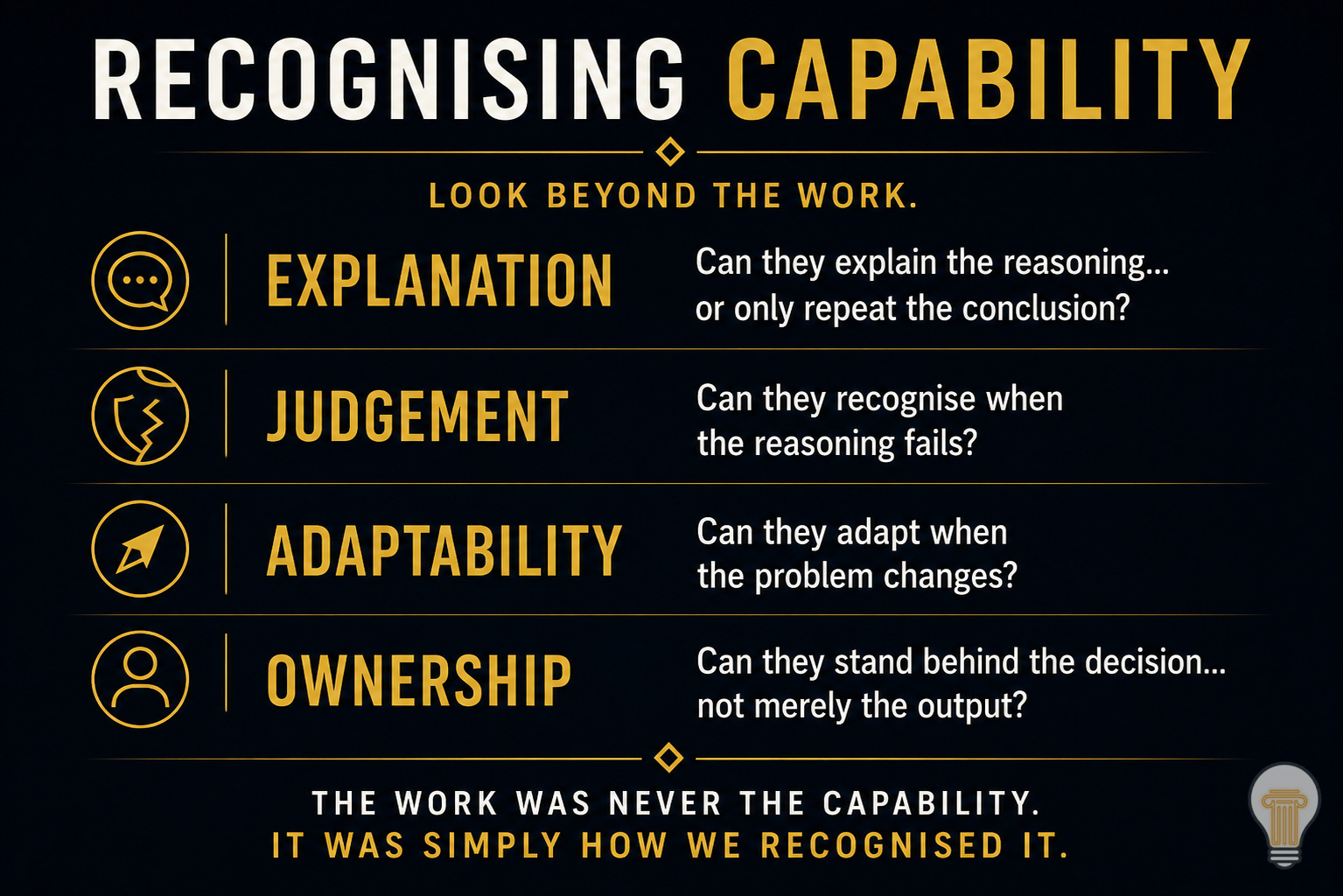
I’ve increasingly found myself returning to four.
Those questions aren’t designed to measure performance.
They’re designed to recognise capability.
Can they explain the reasoning, or only repeat the conclusion?
Can they recognise when the reasoning fails?
Can they adapt when the problem changes?
Can they stand behind the decision, not merely the output?
Taken together, those questions reveal something the work alone never can.
Whether the capability belongs to the person...
or merely passed through them.
That distinction becomes important because every profession eventually encounters problems no-one has solved before.
No training dataset contains tomorrow.
No model has experienced your organisation.
Or your team.
Or the unexpected combination of circumstances that appears only once.
Eventually someone has to decide.
Not retrieve.
Decide.
What Remains
That changes how we think about education.
For years universities have assessed what students produce.
Increasingly they’ll need to reveal how students think.
Not because essays have become obsolete.
Because essays no longer reveal what they once did.
The objective isn’t to catch students using AI.
But to create learning experiences where judgement becomes visible again.
The same shift applies to organisations.
For years leaders have asked:
How do we make people more productive?
That’s still an important question.
But it isn’t sufficient anymore.
Another now sits beside it.
What kind of capability is this system developing?
Those questions don’t always produce the same answer.
Reward polished presentations and you’ll receive polished presentations.
Reward immediate output and you’ll receive immediate output.
Reward the appearance of capability and people will become remarkably good at producing its appearance.
Every system eventually becomes a system for producing the evidence it rewards.
That has always been true.
AI just makes it harder to ignore.
Technology has always changed what becomes commonplace.
Printing made copying less valuable.
Search made retrieving information less valuable.
Generative AI is making competent production less distinctive.
Each time, people predicted the decline of an essential human capability.
Each time, something subtler happened.
The technology reduced the value of one visible signal.
It increased the value of a less visible capability beneath it.
Printing didn’t reduce the value of understanding.
Search didn’t reduce the value of judgement.
Generative AI won’t reduce the value of capability.
It reduces the value of using competent work as evidence of capability.
Those are very different things.
Technology rarely changes what ultimately matters.
It changes what no longer distinguishes us.
For centuries, good work usually told us something true about the person who produced it.
That relationship hasn’t disappeared.
But it has become noisier.
The temptation is to defend yesterday’s signals.
To make work harder.
To preserve familiar assessments.
To mistake inconvenience for rigour.
History suggests that rarely works.
Technology changes.
Signals change with it.
Human capability develops much more slowly.
The work was never the capability.
It was how we recognised it.
The question isn’t whether AI can produce competent work.
It clearly can.
The question is whether our universities, organisations and professions still know how to recognise, develop and reward the capabilities that remain when competent work becomes ordinary.
Because those were always the capabilities that mattered.
The section on "friction" really stayed with me.
We've spent years trying to remove friction from work, but some of it is exactly what shapes judgment. The real challenge isn't eliminating friction, it's knowing which friction is waste, and which is actually the training.
Absolutely love this article. I think it’s important to keep developing our thinking around human value and capability, and finding ways to identify it openly, for the sake of the younger generations and their identity, self-worth and contribution to society