
AI Will Scale Your Dysfunction
Why most AI adoption strategies fail before they begin

Nearly 90% of enterprises are now using AI in some form.
Yet around 95% of generative AI pilots fail to move beyond experimentation, and 56% of CEOs report getting “nothing” from their AI adoption efforts (Finzarc, 2026; Larridin, 2026).
That gap is not a tooling problem.
It’s a maturity problem.
We’ve been doing technology wrong for years.
AI is simply making it visible.

The IT-ification Trap
For two decades, most organisations have treated technology as:
A tool to buy
A system to install
A workflow to digitise
That model works when the technology changes storage or interface.
It breaks when the technology changes cognition.
Generative AI doesn’t just optimise processes. It reshapes how people draft, analyse, decide, and allocate attention.
Yet most organisations still approach AI by asking:
“Which tool should we buy?”
Rather than:
“How should AI reshape our strategy?”
This pattern has been repeatedly identified as the central adoption failure (Canducci, 2025; Pirenne, 2026)
So what happens?
Enterprise subscriptions are signed.
Microsoft Copilot is enabled.
ChatGPT is approved.
A few webinars are delivered.
And then nothing fundamental changes.
The result is what I call procurement theatre.
AI as a Cultural Stress Test
The data suggests the barriers to scaling AI are predominantly organisational, not technical.
Top reported challenges include:
Unknown workforce adoption rates (45.6%)
Inconsistent AI governance (37.1%)
Unclear value metrics (28.9%)
Integration and risk concerns (Deloitte, 2025)
These are not engineering failures.
They are leadership failures.
As one 2026 enterprise analysis bluntly notes, only 1% of organisations consider their AI efforts “mature” (Finzarc, 2026).
AI does not transform organisations.
It amplifies them.
If you have:
Clear strategy → AI accelerates it.
Messy processes → AI automates the mess.
Strong judgement culture → AI augments it.
Fear-driven culture → AI becomes a crutch or a secret.
In The Stoic Futurist’s Cognitive Firewall, I argued that AI didn’t create the judgement problem. It exposed it (Smith, 2026a).
At organisational scale, the same dynamic holds.
The Awareness Gap, Scaled
In Don’t Be a Jarrod, I wrote that presence is not what you feel. It’s what others experience (Smith, 2026b).
Most organisations are Jarrod with AI.
From the executive chair:
“We’ve rolled it out.”
“We’ve invested.”
“We’re ahead.”
From the ground:
No redesigned workflows.
No shared norms of verification.
No clarity about accountability for AI-influenced decisions.
Meanwhile, shadow AI spreads quietly. Over half of employees using AI at work are doing so “under the radar,” and fewer than half have received formal training (Kavanaugh, 2025)
Shadow AI becomes shadow infrastructure.
Dependency builds before governance catches up (Varavooru, 2026)
The organisation feels innovative.
The system is fragmenting.
Why Pilots Don’t Scale
The pattern is consistent.
Organisations:
Pilot a tool.
Measure time saved.
Celebrate productivity.
Attempt broader rollout.
Encounter resistance, inconsistency, risk, cultural friction.
Stall.
As Deloitte (2025) and Canducci (2025) both observe, scaling barriers are rarely about model performance. They are about governance, adoption, and alignment
You cannot pour new cognitive capacity into old incentives.
If performance reviews reward visible busyness, AI will accelerate visible busyness.
If leaders punish uncertainty, people will either hide AI use or outsource thinking to it.
If decision rights are unclear, AI outputs will quietly seep into reports, policies, and models without traceable accountability (Varavooru, 2026)
This is culture design.
IT cannot solve it.
The Deskilling Risk
There is another danger.
Deskilling.
Research has already documented cases where automation eroded professional competence to the point that employees could no longer perform core tasks when systems were removed (Aalto University, 2025; Greengard, 2025)
The better question is not:
“How many tasks can we automate?”
It is:
“Which human capabilities must we protect?”
That reframes AI from replacement to augmentation (Canducci, 2025)
Without that discipline, you build invisible fragility.
Systems that work beautifully under normal conditions.
And collapse when novelty demands real judgement.
From Tool Rollout to Cognitive Infrastructure
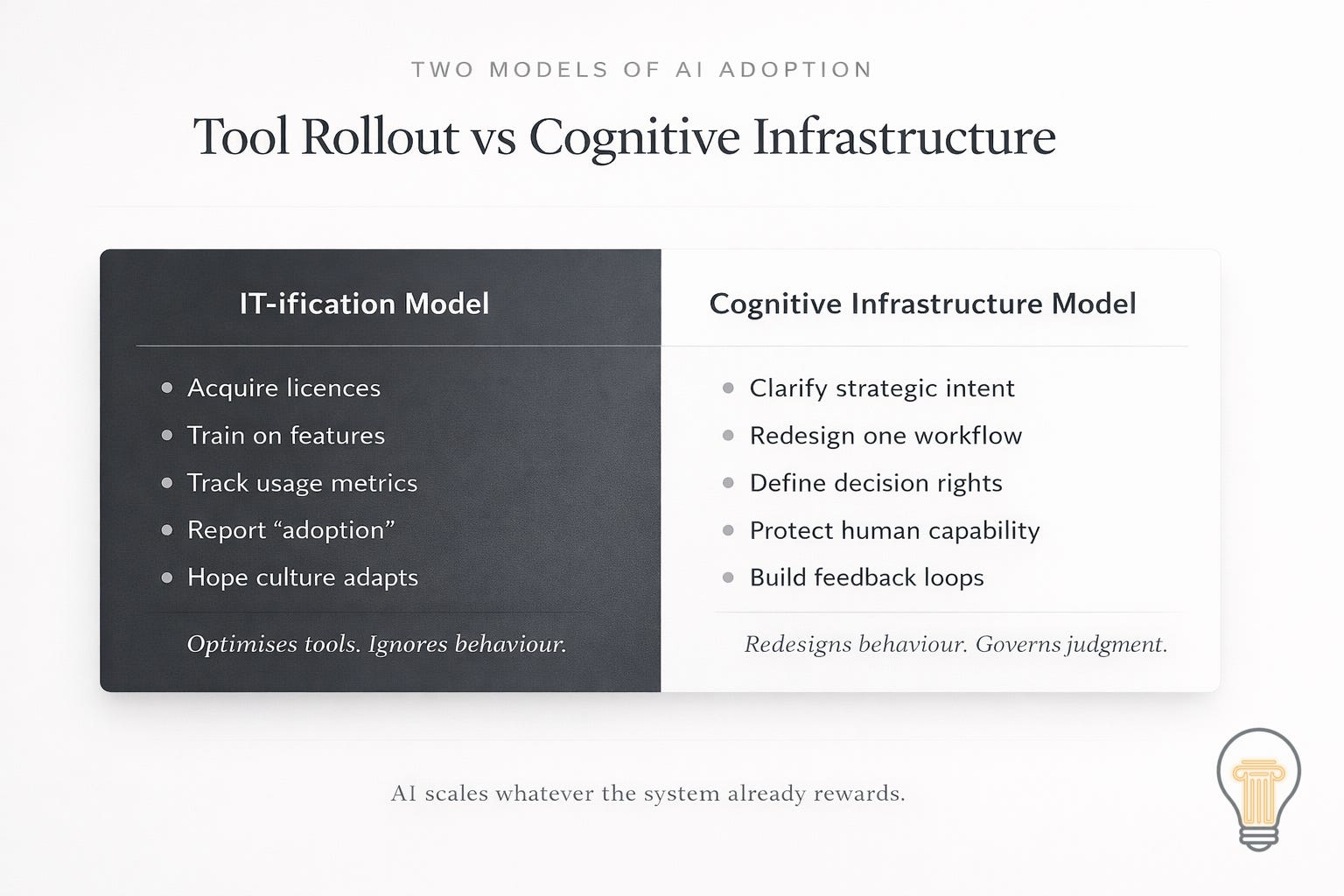
Here is the structural distinction.
IT-ification Model
Acquire tool
Train on features
Track usage
Report adoption metrics
Cognitive Infrastructure Model
Clarify strategic intent
Redesign 1–2 workflows assuming AI is always present
Define decision rights for AI-assisted outputs
Protect critical human capabilities
Build shared feedback loops
The difference is philosophical.
One treats AI as plumbing.
The other treats AI as organisational cognition.
This is not anti-technology, but it is anti-naivety.
As I wrote in the Cognitive Firewall, tools should function as assistants, not oracles (Smith, 2026a)
At organisational scale, the same principle applies.
Authority must remain human.
A Better Pilot
If you are a middle manager inside an AI-enabled organisation, here is a more honest experiment than “roll out Microsoft Copilot.”
Don’t pilot the tool.
Pilot a micro-culture.
For 30 days:
Assume AI is always available.
Redesign one core workflow accordingly.
Introduce a lightweight decision log for AI-assisted outputs.
Identify 2–3 capabilities that must still be practised unaided.
Run a pre-mortem: “If this fails publicly in 12 months, why?”
This mirrors the pre-mortem discipline described in the Stoic Futurist toolkit (Smith, 2026a).
It shifts the question from:
“Does this tool work?”
To:
“What kind of organisation are we becoming?”
The Real Divide
The emerging divide is not between organisations that “have AI” and those that don’t.
Powerful AI tools are increasingly accessible (Finzarc, 2026)
The divide is between organisations asking shopping questions.
And those asking structural questions.
AI will scale whatever you already are.
Before your next AI initiative, ask:
What behaviour have we actually redesigned?
I’m curious - in your organisation, what has genuinely changed since AI was “rolled out”?
AI doesn’t remove ambiguity. It increases the speed at which ambiguity spreads.
"We’ve been doing technology wrong for years. AI is simply making it visible."
This is the crux of it all. It's just painfully obvious now.