
Fluent Misunderstanding
Why better communication begins with accepting that meaning isn’t yours to control

Years ago, I wrote an article about cross-cultural communication.
The premise was sensible enough.
If you work with people from different cultures, learn how they communicate.
Pay attention to context.
Avoid idioms that don’t travel well.
Understand that directness, disagreement, hierarchy and trust don’t work the same way everywhere.
I still believe most of that.
But I now think I was solving the smaller problem.
I treated cross-cultural communication largely as a knowledge problem. Learn enough about another culture and you become less likely to misunderstand the people within it.
Knowledge helps.
It just doesn’t solve the problem.
You can study Japanese business etiquette and still misunderstand the Japanese person sitting opposite you.
You can speak the same language, work for the same organisation and have known someone for ten years and still leave a meeting with completely different ideas about what was agreed.
The deeper problem is interpretation.
And technology is making that problem easier to miss.
AI can translate a conversation almost instantly. It can rewrite an email for another audience, remove idioms, adjust tone and turn an awkward jumble into polished prose.
All useful.
But better language doesn’t guarantee better understanding.
An email can be beautifully written and leave two people with different expectations.
A meeting can end with everyone nodding and nobody quite agreeing on what happens next.
I think of this as fluent misunderstanding.
It happens when communication looks successful because the words are clear.
Nobody asks for clarification.
Nobody looks confused.
Everyone nods and moves on.
The problem only becomes visible later, when people act on different versions of the same conversation.
Obvious confusion is inconvenient.
Fluent misunderstanding is more dangerous.
Confusion announces itself.
Fluency can hide that gap.

The message is not the meaning
Consider a manager saying:
“I’d like you to have another look at this.”
Simple enough.
Except it might mean:
Make a few changes.
This isn’t good enough.
Start again.
I’m not convinced yet.
Or, occasionally, exactly what the words say.
Most of the time we don’t notice ourselves doing this interpretive work.
We combine the words with who said them, how they said them, what happened beforehand, our relationship and what people around here normally mean by things like that.
This works surprisingly well.
Until some of those assumptions aren’t shared.
Cross-cultural communication makes the problem particularly visible.
Edward Hall’s distinction between high- and low-context cultures is useful here. In some environments, more meaning tends to be made explicit. In others, more can be left to relationships, convention and context (Hall, 1976).
Useful distinction.
Dangerous stereotype.
Knowing that someone’s cultural background may shape how they communicate should make us more curious about what they mean, not more confident that we already know.
People aren’t national averages.
There is substantial cultural variation within countries as well as between them, which is one reason country-level frameworks become unreliable when we use them to predict individuals (Beugelsdijk, Kostova and Roth, 2017).
And national culture is only one source of difference.
An engineer and a marketer can misunderstand one another.
So can a CEO and a graduate.
Even two people who grew up in the same suburb.
Every group develops assumptions about what can safely remain unsaid.
Cross-cultural communication just makes those assumptions harder to hide.
Culture changes the interpretation gap. It doesn’t create it.
That’s the more durable lesson.
We tend to judge communication from the sender’s side:
Was I clear?
But clarity only tells us something about the message we produced.
It doesn’t tell us what happened when that message reached another mind.
Transmission is what leaves you. Understanding is what happens between you.
And that creates a problem.
If I can’t completely control what you understand, and you can’t directly know what I intended, both of us are interpreting.
Usually at speed.
Often with incomplete information.
And with far more confidence than we realise.
The Stoics had a word for the moment where that becomes dangerous.
Assent.
The judgement between the words
The Stoics were wary of accepting first impressions too quickly.
Not because those impressions are always wrong.
Because they arrive before judgement has had much opportunity to intervene.
Epictetus described the discipline of assent. The examining of an impression before accepting it as true.
That matters surprisingly often in communication.
A colleague doesn’t reply to your email.
What happened?
Well… they haven’t replied.
But that rarely remains the story for long.
“They’re ignoring me.”
”They’re annoyed.”
”They don’t think this is important.”
”I’ve offended them.”
Perhaps.
But somewhere between the unread email and the conclusion, interpretation became fact.
This is the problem I originally built the Cognitive Firewall to address. It slows the movement from information to belief or action.
The same principle applies here:
Don’t confuse the impression with the judgement you’ve made about it.
One question does a lot of the work:
What did they actually say, and what have I added?
The point isn’t to distrust your judgement.
It’s to notice that you’ve made one.
The sender has the same problem
There is an equal and opposite mistake on the other side of the conversation.
We’ve all defended ourselves with some version of:
“That’s not what I meant.”
Fair enough.
But intention doesn’t settle the matter.
The other person never received your intention directly. They received your words, tone, timing, behaviour and whatever context the two of you did or didn’t share.
Your intention is part of the evidence.
It isn’t the verdict.
This becomes particularly visible across cultures.
Directness intended as efficiency can land as disrespect. Indirectness intended as courtesy can land as evasion. Silence intended as consideration can be interpreted as agreement.
The receiver knows what they understood.
The sender knows what they intended.
Neither, alone, knows whether the two match.
That gives us two disciplines:
As receiver, hold your interpretation lightly.
As sender, hold your intention lightly.
This doesn’t mean refusing to reach conclusions. Good judgement requires them.
The Stoic discipline concerns what happens before the conclusion hardens.
Create enough distance to ask whether the evidence supports the story you’ve attached to it.
That protects individual judgement.
But communication involves more than one mind.
Eventually, our private interpretations have to meet.
If misunderstanding is inevitable, even among competent people acting in good faith, better communication cannot mean eliminating it.
We need to become better at finding it.
Repair is the capability
There is a comforting idea behind a lot of communication advice.
If we choose our words carefully enough, provide enough context and listen closely enough, everyone will understand one another.
Sometimes they will.
But misunderstanding isn’t an unusual malfunction in human communication.
It’s part of the machinery.
We mishear. We assume. We use the same words differently. Sometimes we realise halfway through a conversation that we’re answering different questions.
Then we repair.
“When you say approved, do you mean approved to proceed?”
“No, that’s not quite what I meant.”
“Let me check I’ve understood you.”
These interruptions can feel inefficient.
But they are often the moment communication actually starts happening.
Researchers Herbert Clark and Susan Brennan called the underlying process Grounding. Establishing enough shared understanding for the purpose at hand. Understanding isn’t simply delivered by one person. It is built and tested between them (Clark and Brennan, 1991).
That gives us a more realistic standard.
We don’t need perfect mutual understanding.
We need enough for what happens next.
“Coffee at ten?” probably doesn’t require a formal read-back.
“Go ahead with the restructure” might.
Research across 12 languages from eight language families has also found striking similarities in how people signal and repair problems of understanding (Dingemanse et al., 2015).
Misunderstanding happens.
The capability is in finding it.
A good communicator doesn’t eliminate misunderstanding. They make it easier to discover.
The friction that protects understanding
This is where Required Friction becomes useful.
I developed the idea around a simple distinction that some friction is waste, but some keeps us in contact with reality.
Communication has its own Required Friction.
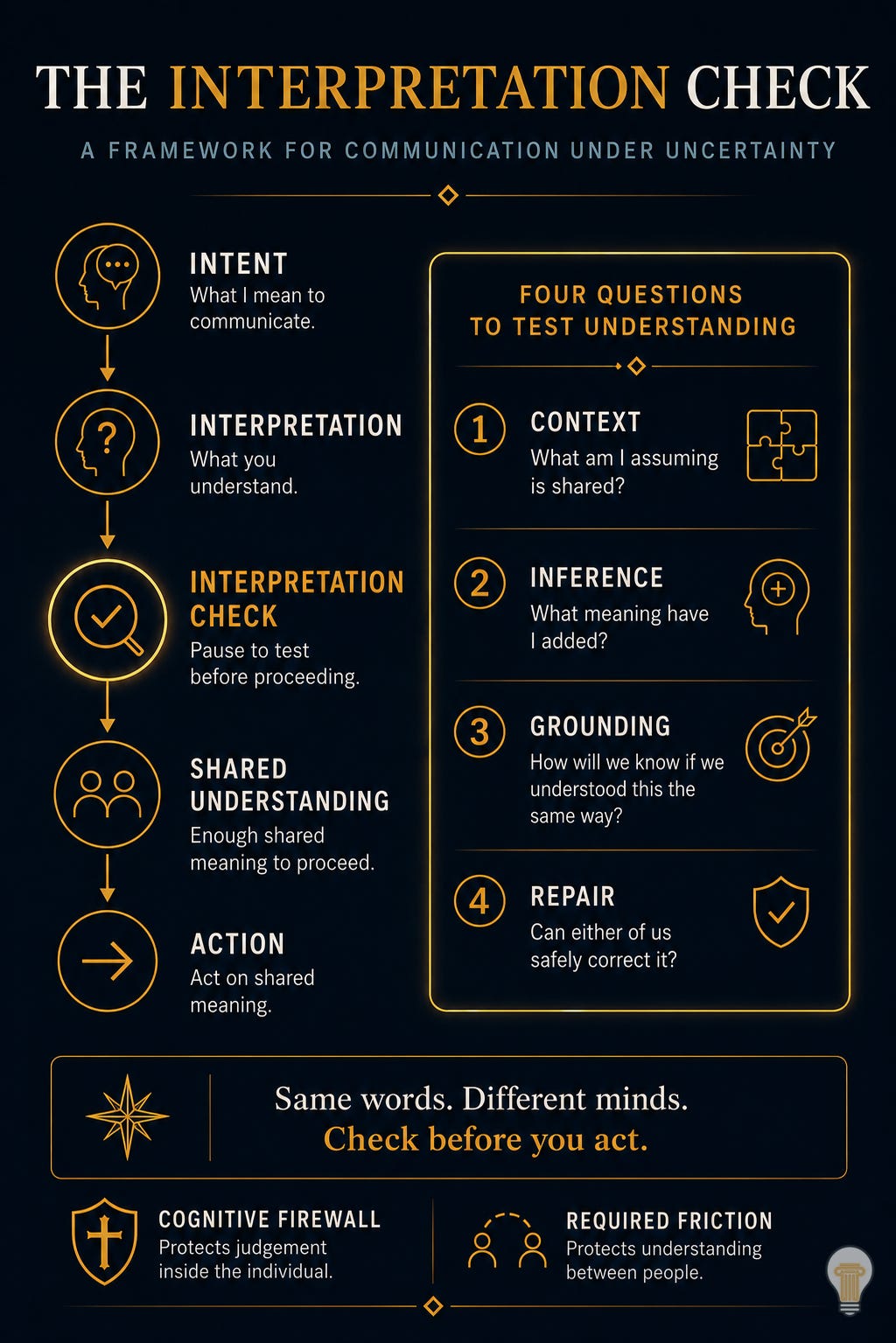
Consider the sequence:
Intent → Interpretation → Shared Understanding → Action
The dangerous shortcut is from interpretation straight to action.
I say something.
You interpret it.
We assume we’re aligned.
Work begins.
The misunderstanding appears three weeks later.
Required Friction interrupts that sequence long enough to test it.
A clarifying question.
A paraphrase.
Written confirmation after a complicated meeting.
Moving an ambiguous email into a conversation.
Even leaving enough silence in the meeting for someone to disagree.
The point isn’t to make communication cumbersome. It’s to accept a small cost now when the cost of misunderstanding later could be much larger.
But there is a limit.
You cannot repair a misunderstanding you aren’t allowed to name.
A junior employee may recognise that a senior executive has misunderstood them and decide that correction or clarification isn’t worth the risk. A team may claim to welcome challenge while repeatedly punishing the people who provide it.
At that point, communication becomes a systems problem.
A communication system is only as repairable as the people inside it are free to correct one another.
That matters particularly for leaders.
The more authority you have, the less you can rely on silence as evidence of understanding.
People may nod because they understand.
They may also nod because disagreeing is expensive.
So the better question isn’t only:
Was I clear?
It’s:
What have I done to make misunderstanding safe to reveal?
Communication doesn’t become more resilient when nobody gets anything wrong.
It becomes more resilient when being wrong is cheap enough to discover early.
Direct is not the same as honest
We often treat direct communication as better communication.
Say what you mean. Be clear. Don’t dance around the issue.
There is good reason for this. Ambiguity can waste time, and politeness can become a convenient way to avoid saying what needs to be said.
But directness and honesty are not the same thing.
You can be direct and dishonest.
You can be direct and unnecessarily destructive.
You can be indirect while remaining entirely truthful.
This becomes particularly obvious across cultures.
Erin Meyer’s Culture Map, for example, distinguishes between cultures where negative feedback tends to be expressed directly and those where it is more often softened or conveyed indirectly (Meyer, 2014).
The disagreement may be identical.
The way it is carried differs.
Truthfulness and directness sit on different axes.
That distinction is important beyond national culture.
Directness is a communication style. Honesty is an ethical commitment.
Wisdom determines how one should be expressed through the other.
The Stoics understood this. Seneca could be remarkably frank, but his letters also reveal an attentiveness to audience, timing and the purpose of speaking.
The question isn’t just:
Is this true?
It’s also:
What does wisdom require me to do with the truth here?
Sometimes greater directness is exactly what the situation requires.
Sometimes it is the communicative equivalent of using a hammer because you happen to admire hammers.
The Stoic Futurist has a harder job.
Tell the truth.
But don’t confuse your preferred way of telling it with the truth itself.
When fluency hides uncertainty
This is where AI complicates things.
It is increasingly easy to ask a tool to:
Make this warmer.
Make this more direct.
Rewrite this for a Japanese audience.
Make this sound more empathetic.
Useful prompts.
Up to a point.
AI can offer alternative formulations, identify idioms that may not travel well and show how a message might sound when expressed more or less directly.
The danger begins when assistance becomes authority.
We can outsource not just expression, but context.
Ask an AI how “a German” or “a Japanese person” will interpret something and it can produce an impressively fluent explanation.
That fluency can make the generalisation feel more certain than it deserves. Research evaluating large language models on culturally grounded tasks has found uneven performance across cultures and cultural knowledge (Li et al., 2024).
That doesn’t make AI useless here.
It changes how we should use it.
Instead of:
“What does this person mean?”
Try:
“What are three plausible ways this could be interpreted?”
Instead of:
“Rewrite this correctly for their culture.”
Try:
“What assumptions in this message might not be shared?”
Use AI to widen your judgement, not replace it.
There is an irony here.
AI is becoming very good at removing the visible friction of communication.
The translation becomes fluent.
The email becomes polished.
The tone becomes appropriate.
But the uncertainty underneath can remain.
That returns us to the problem we started with.
The future may contain fewer obvious language barriers.
That doesn’t necessarily mean fewer misunderstandings.
It may just mean more fluent ones.
The Interpretation Check
Not every conversation needs more friction.
If I ask where the meeting is and you say “Room 204”, we probably don’t need to compare interpretations.
But as ambiguity, difference or consequence increases, so does the cost of assuming we understand one another.
A performance conversation deserves more checking than a lunch order.
A strategic decision across several disciplines deserves more than an email saying everyone is “aligned”.
A negotiation across unfamiliar cultural contexts deserves more curiosity about what agreement and commitment actually mean.
The point isn’t to make communication laborious.
It’s to recognise when speed creates false confidence.
Four questions help.
1. Context: What am I assuming is shared?
Every message leaves things unsaid.
The question is what can safely remain implicit.
Before an important conversation, consider what you’re assuming the other person already knows: the history, terminology, expectations, prior decisions or even the purpose of the conversation.
The greater the difference in profession, experience, culture or organisational position, the less confidently we should assume that context is shared.
2. Inference: What meaning have I added?
This is the Cognitive Firewall applied to communication.
“They haven’t replied” is an observation.
“They don’t care” is an interpretation.
“They said they could meet the deadline” is an observation.
“They’re comfortable with the deadline” may not be.
The aim isn’t to distrust inference. We couldn’t communicate without it.
It’s to notice which parts of your understanding came from them and which came from you.
3. Grounding: How will we know if we understood this the same way?
For consequential communication, create something both people can correct.
Sometimes one sentence is enough:
“So we’re agreeing that I’ll send the revised version Thursday, and you’ll make the final decision Friday?”
That’s more useful than:
“Does that make sense?”
The first exposes different interpretations.
The second makes “yes” very easy.
4. Repair: Can either of us safely correct it?
If correction carries a social or professional cost, silence tells us very little.
The more authority you have, the more important this becomes.
People need reason to believe that correcting you is actually safe.
These four checks work at two levels.
Context and Inference protect individual judgement.
Grounding and Repair protect shared understanding.
The Cognitive Firewall operates inside the individual. It slows the movement from impression to judgement.
Required Friction operates between people. It creates enough contact for different interpretations to become visible before they turn into consequential action.
The Interpretation Check connects them.
Not every conversation needs to become slower.
Some are just too consequential to remain frictionless.
Understanding is a joint achievement
When I first wrote about cross-cultural communication, I was trying to answer a practical question:
How do we communicate better with people who don’t share our cultural assumptions?
I still think that’s worth answering.
I just wouldn’t start there anymore.
Culture makes the interpretation gap easier to see. So do differences in hierarchy, expertise, profession, language and experience.
The more durable lesson is that we never receive another person’s meaning directly.
We interpret.
So do they.
Learn about culture. Learn the conventions. Notice different expectations around hierarchy, trust, disagreement and directness.
But use that knowledge to become more curious, not more certain.
The person in front of you remains a person.
Not an example of a culture.
That leaves us with a more modest definition of good communication.
Not perfect clarity.
Not perfect cultural competence.
Not the elimination of misunderstanding.
Enough shared understanding to act, and enough capacity for repair when our interpretations diverge.
Communication hasn’t succeeded because I said what I meant.
It succeeds when we’ve done enough work to know what we mean together.
Well written. I got a lot of reminders. Your funhouse mirrors were a great visual.
Brilliant! Thanks for sharing. 😊