
The Future Should Not Surprise You
Why the future belongs to people who rehearse adversity before it arrives

Modern culture has an unusual relationship with the future.
We spend enormous amounts of time worrying about it.
And surprisingly little time preparing for it.
We consume predictions. We debate trends. We imagine success. We hope things work out.
Yet when disruption arrives, many of us are caught off guard.
Not because the event itself was unforeseeable.
Because we never rehearsed how we’d respond.
The Stoics had a name for this rehearsal: premeditatio malorum.
Often translated as the “premeditation of evils”, the practice involved deliberately imagining difficulties before they occurred. Illness. Financial loss. Professional setbacks. The death of loved ones. Political upheaval. Exile.
To modern ears, it sounds like pessimism.
Why spend time thinking about things you hope will never happen?
The Stoics would have answered with a question of their own.
Why spend your life assuming they won’t?
William Irvine (2009) describes this practice as a form of psychological insurance premium. By voluntarily exposing ourselves to controlled discomfort in the present, we reduce the shock of adversity when it eventually arrives. We become less fragile because we’ve already visited the possibility in our minds.
The Stoics understood something many modern leaders, organisations, and institutions seem to forget:
What surprises us controls us.
The unexpected often arrives with a hidden tax. It narrows our options. It hijacks our emotions. It pushes us towards reactive decisions rather than deliberate ones.
This is why premeditatio malorum remains relevant two thousand years later.
Not because it helps us predict the future.
Because it helps us prepare for uncertainty itself.
Stoic Futurism takes this ancient practice a step further.
Anticipation without action becomes anxiety.
Anticipation combined with rehearsal becomes resilience.
Rehearsal embedded into systems becomes a strategic advantage.
This progression matters because the future is not experienced by only individuals. It’s experienced by families, teams, organisations, and societies. Each operates at a different scale. Each requires a different form of preparation.
The practice begins with the smallest system we manage.
Ourselves.

Rehearsing the Self
Most crises are experienced twice.
First as the event.
Then again as our judgement about the event.
A funding application is rejected.
A project fails.
A restructure is announced.
A relationship deteriorates.
The event occurs in reality.
And yet, the real crisis often occurs more in our interpretation of that reality.
This was one of the Stoics’ most important psychological insights (Robertson, 2020). External events are not entirely responsible for our suffering. Our beliefs about those events often play a decisive role.
Modern cognitive behavioural therapy has arrived at a remarkably similar conclusion.
The ABC model proposes that it is not the adversity itself (A) that determines the consequence (C), but the beliefs (B) we attach to it (Neenan, 2017; Robertson, 2020).
Consider two leaders facing the same setback.
One interprets the event as proof of personal failure.
The other interprets it as information.
The external reality is identical.
The internal reality is completely different.
One spirals into frustration, blame, and defensiveness.
The other begins adapting.
This distinction becomes critically important under pressure.
Many organisational failures are not caused by the initial disruption. They are caused by panic-driven responses to the disruption.
The executive who lashes out.
The founder who abandons a strategy after a temporary setback.
The manager who mistakes uncertainty for catastrophe.
The team that confuses discomfort with danger.
In each case, the external challenge is amplified by an internal one.
The Stoics recognised this pattern long before behavioural science existed.
Their solution was rehearsal.
By imagining difficulties in advance, they created space between adversity and reaction.
The goal was never emotional numbness.
The goal was emotional readiness.
I think of this as building a Cognitive Firewall.
A firewall on your computer does not prevent threats from existing.
But it prevents threats from automatically spreading.
Likewise, a cognitive firewall does not stop adversity from entering our lives. It stops adversity from immediately dictating our judgements.
A practical version of premeditatio malorum might involve asking:
What could realistically go wrong?
What would I be tempted to believe if it happened?
Which belief would make the situation worse?
Which interpretation would preserve agency?
What response would still remain within my control?
These questions feel simple.
They are not.
They force us to distinguish between the event and our story about the event.
That distinction is where resilience begins.
The future will eventually test all of us.
The question is whether we encounter that test for the first time when it arrives.
Or whether we’ve already rehearsed it.
The goal isn’t emotional invulnerability. We are human.
The goal is preventing panic from becoming policy.
Rehearsing Gratitude
At first glance, premeditatio malorum appears to be a practice about loss.
In many ways, that’s true.
But that’s only half the story.
The Stoics understood that anticipating loss does something unexpected.
It deepens appreciation.
One of the most persistent features of human psychology is our ability to adapt. We adapt to success. We adapt to comfort. We adapt to relationships. We adapt to achievements that once seemed impossible.
Psychologists refer to this tendency as hedonic adaptation (Brickman & Campbell, 1971).
The new house becomes normal.
The promotion becomes expected.
The healthy body becomes invisible.
The people we love become part of the background scenery of everyday life.
Not because we care less.
Because familiarity slowly reshapes our perception.
This is one of the great paradoxes of being human.
The things that matter most are often those we notice least.
The Stoics developed premeditatio malorum partly as a response to this problem.
By imagining the eventual absence of something, they restored their awareness of its presence.
Epictetus famously advised his students that when kissing their child goodnight, they should remember that the child is mortal.
To modern readers, the advice can feel jarring.
Cruel even.
Why introduce thoughts of mortality into moments of love?
Because the Stoics were not trying to diminish joy.
They were trying to intensify it.
The alternative is surprisingly easy.
We assume there will always be another bedtime.
Another conversation.
Another family dinner.
Another ordinary Tuesday.
Until one day there isn’t.
When I say goodnight to my boys, Nathaniel, Micah, and Rohan, I sometimes think about this Stoic practice.
Not often.
Not obsessively.
But enough to remind myself of something important.
These moments aren’t guaranteed.
One day the house will be quieter.
One day the routines that currently feel exhausting will be memories.
One day I may give almost anything to relive an evening that currently feels very ordinary.
That reflection does not make me sad.
It makes me pay attention in the now.
The purpose of premeditatio malorum is not to borrow grief from the future.
It’s to recover gratitude in the present.
The same principle applies far beyond family life.
Many people spend their lives pursuing the next achievement while remaining blind to what they’ve already built.
The next promotion.
The next opportunity.
The next version of success.
The pursuit itself is not the problem.
The problem arises when desire becomes detached from appreciation.
When every accomplishment immediately becomes insufficient.
When every gain simply creates a new target.
When enough becomes a moving horizon that recedes every time we approach it.
This is where Stoic anticipation becomes a discipline of desire.
By periodically imagining the loss of what we already possess, we weaken the illusion that fulfilment always exists somewhere else.
We become less dependent on future outcomes to justify our present contentment.
This matters strategically as well as personally.
A leader trapped on the hedonic treadmill is easy to destabilise.
Their sense of worth depends on the next achievement.
The next quarter.
The next title.
The next external validation.
A leader who knows what matters most is harder to manipulate.
They are less likely to sacrifice long-term priorities for short-term rewards.
Less likely to panic when status fluctuates.
Less likely to mistake motion for progress.
The Stoics understood that resilience isn’t only about enduring hardship.
It’s also about resisting the endless hunger for more.
Because a person who knows what is enough possesses a rare form of freedom in this consumeristic world.
And a person who can fully appreciate the present is often better prepared to face the future.
You do not fully value something because you possess it.
You fully value it when you realise it was never guaranteed.

Rehearsing Failure
Most organisations investigate failure after it happens.
The project misses its targets.
The implementation stalls.
The product launch disappoints.
The funding dries up.
The partnership collapses.
Only then does the post-mortem begin.
What happened?
What did we miss?
What should we have done differently?
There is obvious value in these questions.
There’s also an obvious limitation.
By the time you ask them, the tuition fee has already been paid.
The Stoics would likely have recognised a more useful alternative.
Ask the questions before reality asks them for you.
This is precisely the logic behind one of the most powerful tools in modern decision-making: the pre-mortem.
Developed by psychologist Gary Klein (1998) and later popularised by Daniel Kahneman (2011), the pre-mortem reverses the normal sequence of organisational learning.
Instead of analysing a failure after it occurs, participants assume the failure has already happened.
The project is dead.
The initiative failed.
The stakeholders are disappointed.
The budget has been exhausted.
The team is burnt out.
The organisation is asking difficult questions.
The task is then deceptively simple:
How did we get here?
Research into what Mitchell, Russo and Pennington (1989) called “prospective hindsight” suggests that imagining a future outcome can significantly improve our ability to identify its causes in advance. By mentally placing ourselves in a future state of failure, we become better at recognising risks that are often hidden by optimism in the present.
This matters because humans are remarkably poor at identifying weaknesses in ideas we are emotionally invested in.
When we build something new, enthusiasm often becomes a filter.
We focus on possibilities.
We minimise obstacles.
We unconsciously seek evidence that confirms our assumptions.
The more excited we become, the more difficult it can be to see fragility.
The pre-mortem creates a temporary suspension of that optimism.
It grants permission to ask uncomfortable questions before they become expensive ones.
Imagine a leadership team launching a major transformation initiative.
Rather than discussing why it will succeed, they begin with a different assumption:
“It is eighteen months from now, and this initiative has failed.”
From there, the conversation changes.
Perhaps key stakeholders never fully supported the change.
Perhaps staff resisted because communication focused on processes rather than purpose.
Perhaps critical dependencies were ignored.
Perhaps funding assumptions proved unrealistic.
Perhaps implementation fatigue emerged far earlier than expected.
Perhaps external conditions changed faster than the strategy.
None of these risks become visible simply because someone is intelligent.
They become visible because someone is willing to imagine failure.
That willingness is surprisingly rare.
Many organisations unintentionally create cultures where doubt is interpreted as disloyalty.
The person raising concerns is labelled negative.
The person asking difficult questions is accused of slowing progress.
The person identifying risks becomes the problem.
The result is predictable.
Potential weaknesses remain hidden until reality exposes them.
The pre-mortem changes this dynamic.
It gives scepticism a legitimate role.
It allows concerns to surface without requiring individuals to position themselves as opponents of the initiative.
The conversation shifts from:
“Why are you being so negative?”
to:
“What are we missing?”
This distinction is profound.
One protects optimism.
The other protects outcomes.
Viewed through a Stoic lens, the pre-mortem is simply premeditatio malorum applied to projects and strategy.
The objective is not to assume failure.
It’s to understand failure well enough to avoid it.
In practice, I’ve found that some of the most valuable discussions in strategy work emerge from this kind of structured anticipation.
Not because people suddenly discover catastrophic flaws.
More often because they slowed down, and were able to uncover small assumptions that had yet not been examined.
A timeline that seemed reasonable.
A dependency that seemed secure.
A stakeholder relationship that seemed stronger than it really was.
These are rarely dramatic discoveries, and that’s kind of the point.
They are usually the sorts of things that remain invisible until someone deliberately looks for them.
The Stoics understood that adversity often arrives long before the crisis itself.
It appears first as ignored warning signs.
Unchallenged assumptions.
Comfortable illusions.
Failure is rarely a single event.
More often, it’s a collection of small vulnerabilities that went unrehearsed.
The pre-mortem helps us find them while change is still possible.
Because the cheapest failure is not the one we recover from.
It is the one that never survives rehearsal.
Rehearsing the Future
There comes a point where personal resilience is no longer enough.
A leader may be emotionally composed.
A team may conduct excellent pre-mortems.
An organisation may have robust processes.
And yet, they can still be blindsided.
Not because they lacked discipline.
Because they underestimated complexity.
Complex systems fail differently from simple ones.
A simple system breaks in a predictable way.
A complex system breaks through interactions:
A regulatory change affects incentives.
Incentives alter behaviour.
Behaviour shifts markets.
Markets reshape institutions.
Institutions influence expectations.
And suddenly an event that appeared isolated has produced consequences far beyond its original scope.
This is why forecasting has limits.
The future is rarely difficult because it’s completely unknowable.
The future is difficult because second and third-order effects are often invisible until they are already unfolding.
Pierre Wack, one of the pioneers of scenario planning at Royal Dutch Shell, recognised this decades ago (Wack, 1985).
His insight was brilliantly simple.
The purpose of scenario planning is not to predict the future correctly.
It’s to prepare decision-makers to operate across multiple plausible futures.
The objective is not certainty.
The objective is adaptability.
This distinction is important.
Many organisations still approach strategy as a prediction exercise.
They build plans around a single expected future and hope reality cooperates.
Sometimes it does.
Increasingly, it does not.
Hope is not a strategy.
Technological change, geopolitical instability, demographic shifts, and economic uncertainty have made single-path planning increasingly fragile.
The organisations that thrive are often not the ones with the most accurate forecasts.
They’re the ones with the greatest capacity to adjust and adapt.
This is where premeditatio malorum evolves into something more significant.
The individual imagines adversity.
The organisation simulates it.
One of the most effective ways to do this is through tabletop exercises and strategic wargaming.
The term “wargaming” may sound dramatic.
In practice, it’s just structured rehearsal.
A future scenario is created.
Participants are assigned roles.
New information is introduced.
Decisions must be made.
Consequences unfold.
The simulation continues.
The value emerges from what participants reveal about themselves and their assumptions.
Consider a university exploring the long-term implications of artificial intelligence.
A traditional planning session might produce a list of opportunities and risks, which are then ranked by some matrix.
A tabletop exercise goes further.
Imagine it is three years from now.
A major AI provider has released a personalised learning platform that significantly outperforms traditional support services.
Students increasingly expect on-demand, adaptive assistance.
Enrolment patterns begin shifting.
New competitors emerge.
Government policy changes.
Media narratives intensify.
What happens next?
What decisions would leadership make?
Where would the institution struggle?
Which assumptions no longer hold?
What capabilities suddenly become critical?
The point is not whether this exact scenario occurs.
The point is whether the organisation discovers vulnerabilities while the stakes are still low.
The same principle can be applied almost anywhere.
A business can rehearse the sudden loss of a major client.
A government agency can rehearse a cyber incident.
A healthcare provider can rehearse supply chain disruption.
A university can rehearse shifts in student demand.
A family can rehearse financial hardship.
A community can rehearse natural disasters.
The underlying logic remains constant.
The future becomes less threatening when it becomes no longer unfamiliar.
What makes tabletop exercises particularly valuable is that they reveal behaviour rather than opinions. Opinions are easily dismissed, behaviour is mechanical – harder to ignore.
People often describe themselves differently from how they act under pressure.
Plans frequently appear stronger on paper than they do in reality.
Assumptions that seem obvious in a meeting room can unravel within minutes of a simulation.
A spreadsheet can model exposure.
A simulation can reveal behaviour.
This is where the Stoic and the strategist unexpectedly meet.
Both understand that preparation is not primarily about information.
It’s about response.
The Stoics rehearsed adversity because they knew events would eventually test their character.
Modern organisations should rehearse disruption because events will eventually test systems.
In both cases, the objective is the same.
To encounter reality for the second time rather than the first.
Because preparedness is not knowing exactly what will happen.
Preparedness is knowing that whatever happens, you have already begun practising your response.
The Rehearsal Advantage
Most people want certainty.
That’s a very understandable desire.
Certainty feels safe.
It allows us to make plans with confidence. It gives us the comforting illusion that the future can be controlled if we simply gather enough information. If we account for enough variables.
The Stoics took a different view.
They understood that uncertainty is not a flaw in reality.
It’s one of the defining features.
No amount of intelligence can eliminate it.
No amount of planning can remove it entirely.
No forecast survives contact with the future unchanged.
This is why premeditatio malorum remains a powerful practice.
Not because it teaches prediction.
Because it teaches preparation.
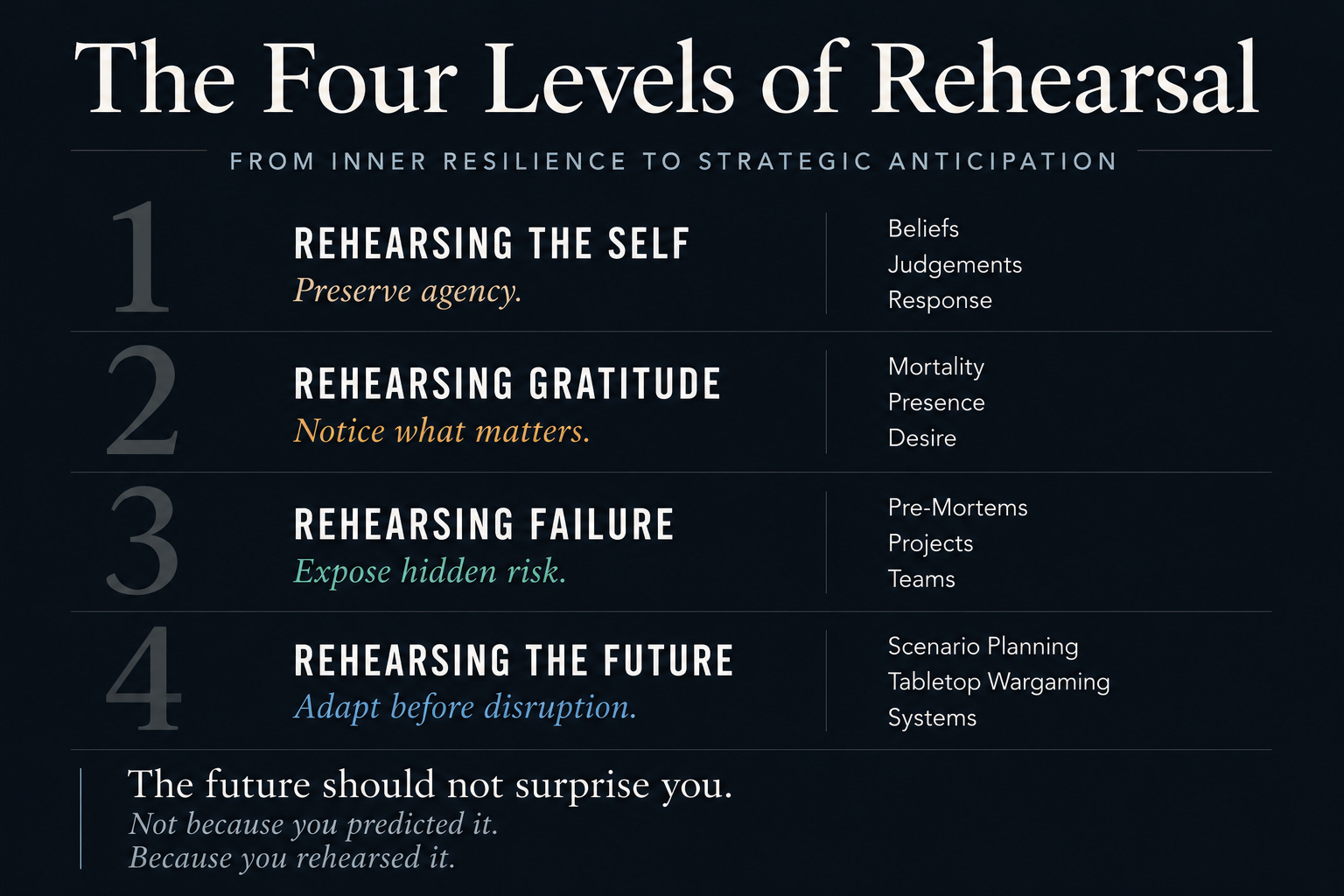
Throughout this article, we’ve followed that preparation through four levels of increasing complexity.
At the personal level, rehearsal creates a cognitive firewall between adversity and reaction.
At the relational level, rehearsal restores gratitude by reminding us that what matters most is never guaranteed.
At the organisational level, rehearsal exposes hidden vulnerabilities before they become expensive failures.
At the systemic level, rehearsal helps us navigate futures too complex to forecast with confidence.
Each level builds on the last.
Each develops the same underlying capability:
The ability to remain effective when reality refuses to follow the script.
This, ultimately, is the difference between anxiety and preparation.
Anxiety imagines the future and becomes overwhelmed.
Preparation imagines the future and becomes ready.
Anxiety asks:
“What if something goes wrong?”
Preparation asks:
“What will I do if it does?”
The Stoics were not interested in becoming fearless.
But they were interested in becoming less surprised.
That’s an important distinction.
Because surprise has a cost.
It narrows options.
It amplifies emotions.
It pushes individuals and institutions towards reactive decisions at precisely the moment clear judgement is most needed.
The future will surprise all of us in its details.
New technologies will emerge.
Institutions will change.
Careers will evolve.
Relationships will deepen and end.
Unexpected opportunities will appear.
Unexpected losses will arrive.
No amount of wisdom can eliminate these surprises.
But their existence should not surprise us.
Disruption is normal.
Change is normal.
Uncertainty is normal.
Stoic Futurists understands this.
They do not attempt to predict every twist and turn of the road ahead.
Instead, they cultivate the capacity to meet whatever emerges.
They rehearse.
They stress test assumptions.
They imagine difficulties before they arrive.
Not because they expect the worst to happen.
Because they intend to remain capable regardless of what happens.
While others wait for certainty before acting, they build resilience.
While others chase perfect forecasts, they cultivate adaptability.
While others hope reality will cooperate, they prepare for the possibility that it will not.
The future belongs less to those who predict correctly than to those who have practised responding wisely.
And that is why the future should not surprise you.
The pre-mortem is the most underused leadership tool I know. Not because leaders don’t know about it. Because admitting what could fail feels like a betrayal of the vision.
The real gap isn’t method. It’s permission. Most teams never get explicit permission to imagine failure without being labeled a skeptic or a drag on momentum.
I’ve watched seasoned leaders, people with decades of experience, skip this step entirely because the culture punished doubt. They called it faith. It was actually avoidance.
The shift happens when a leader learns to hold conviction and honest assessment at the same time. That’s not pessimism. That’s stewardship of the mission.
I don't need to think of the worst... ever. All I have to do is ask myself if I can NOT do something.
Example: Get out of bed. Can I just stay in bed today and live with myself?
If the answer is yes... I can hide from everything I can possibly hide from today and not regret it. Then... there we go. No need to ask what the worst that could happen is. I have to do it anyway.
https://viscousdog.substack.com/p/e4-the-outer-edge-of-good-taste-s7?r=3zlz74&utm_campaign=post&utm_medium=web&showWelcomeOnShare=true