
The Work Should Outlast You
Horizon Thinking — Part 4 of ARCHITECT: How to build beyond the next deadline

The department looked successful
On paper, the department was thriving.
The previous director hit every quarterly KPI.
They launched a visible transformation initiative.
Presented well at town halls.
Collected strong performance reviews.
Earned the promotion.
Then Alex inherited the team.
And discovered the truth.
There was no meaningful documentation.
The tech stack was held together by workarounds nobody fully understood.
The team was exhausted.
Critical decisions lived entirely inside private inboxes and people’s memories.
Routine tasks required constant escalation because nobody trusted the underlying process.
The system only functioned because a handful of experienced staff were compensating manually for all this hidden fragility.
The predecessor did not fail their targets.
They failed the system.
This is one of the most common experiences in modern organisational life:
You inherit something that looked successful from a distance and realise it was financed by future damage.

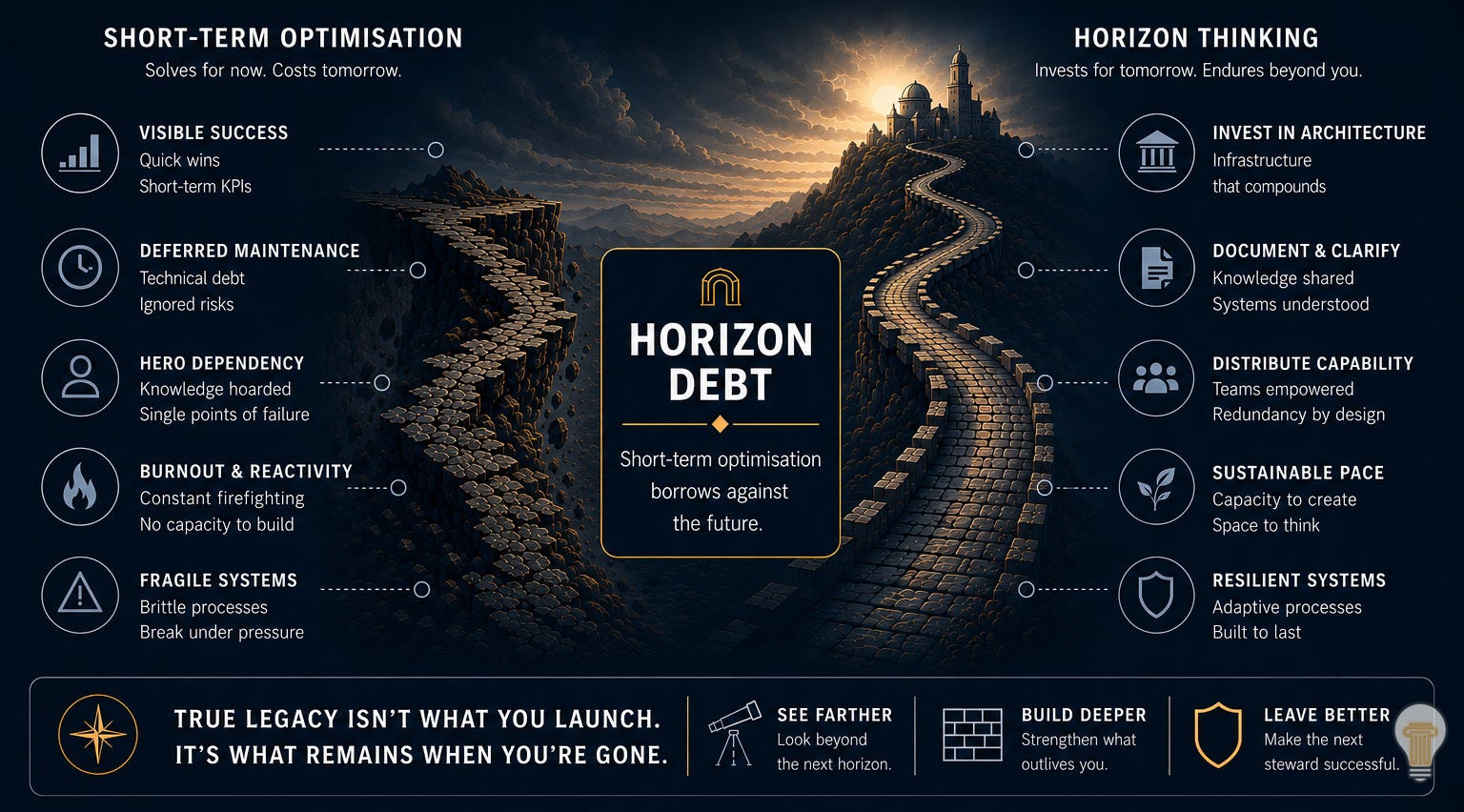
Horizon Debt
Most organisations are built around short-term visibility.
the quarterly report
the annual performance cycle
the project milestone
the election cycle
the funding round
the next restructure
This creates a predictable incentive structure.
Solve the immediate problem.
Push the cost into the future.
I call this Horizon Debt.
Horizon Debt is the future cost created when leaders optimise the present by neglecting the systems, people, and capabilities that tomorrow will depend on.
It appears everywhere:
delaying maintenance to protect this year’s budget
overloading strong staff because training replacements takes time
launching visible initiatives while ignoring invisible infrastructure
avoiding difficult decisions because the political cost is immediate
hoarding institutional knowledge because documenting it slows delivery today
The system appears productive in the short term.
But somebody eventually inherits the bill.
This is a measurable pattern across organisations and has been for a while.
In a landmark study published in the Journal of Accounting and Economics, found that 78% of executives would sacrifice long-term value in order to meet short-term performance targets (Graham, Harvey and Rajgopal, 2005).
The reason?
The system rewarded them for doing so.
Short-termism is rarely announced as short-termism.
It usually arrives disguised as urgent need.
Phase 2 begins here
Phase 1 of ARCHITECT was about reclaiming operational control.
Asymmetric Action removed disposable work
Required Friction protected judgement
Calm Consistency stabilised execution
Alex finally has their head above water.
The daily system is no longer consuming the entire nervous system.
Now the question changes.
Not:
“How do I survive this week?”
But:
“What am I actually building?”
This is where Phase 2 begins.
Not with yet another productivity technique.
But with a confrontation.
You are going to leave unfinished work behind.
The only real question is whether the system becomes more capable because of your time there, or more fragile.
Horizon Thinking
This is the fourth pillar.
Horizon Thinking is the discipline of building structural capacity beyond the visible reporting cycle.
Or more simply:
Horizon Thinking means making decisions your future successor will thank you for, even if nobody rewards you now.
This is not:
abstract futurism
five-year-plan theatre
ignoring present responsibilities
sacrificing today for fantasy strategy
I want it to be practical stewardship.
Horizon Thinking means:
documenting what matters before it disappears
reducing future dependency on individual heroics
maintaining infrastructure before it collapses
developing people beyond your immediate need
building systems that outlast your own incentives
A horizon thinker doesn’t go to the extremes of either being consumed by or escaping the present.
What they do is stop allowing the present to cannibalise the future.
The infinite game
James P. Carse drew a distinction between finite and infinite games.
Finite players play to win.
Infinite players play to ensure the game continues (Carse, 2013).
Many leaders operate entirely inside finite horizons:
hit the metric
survive the restructure
secure the promotion
finish the project
avoid the political loss
The problem isn’t that these goals exist. That would be a mistake.
The problem is when they become the only thing on the horizon.
The institution slowly loses its ability to:
adapt
maintain capability
transfer knowledge
invest patiently
survive disruption
Organisational theorist James March described a similar tension between exploitation and exploration (March, 1991).
Exploitation focuses on refining existing systems and extracting immediate value.
Exploration builds future capability through experimentation, learning, and adaptation.
Exploitation keeps the lights on.
Exploration keeps the organisation from becoming obsolete.
The danger here is entirely predictable.
Under pressure, organisations default toward exploitation because its rewards are immediate and measurable.
But over time, this creates a system highly optimised for the present and dangerously unprepared for the future.
This is why so many organisations become efficient right before they become irrelevant.
The Stoic turn
Stoicism strips away the fantasy of permanence.
Marcus Aurelius repeatedly reminded himself that recognition fades, positions disappear, and personal glory evaporates.
What remains is whether you acted well inside your sphere of responsibility.
Stoic Futurism applies this directly to leadership.
You do not control how your work will be remembered.
What you can control is whether you leave the system more capable than you found it.
Legacy is not what people say about you after you leave.
It’s what still works when you’re gone.
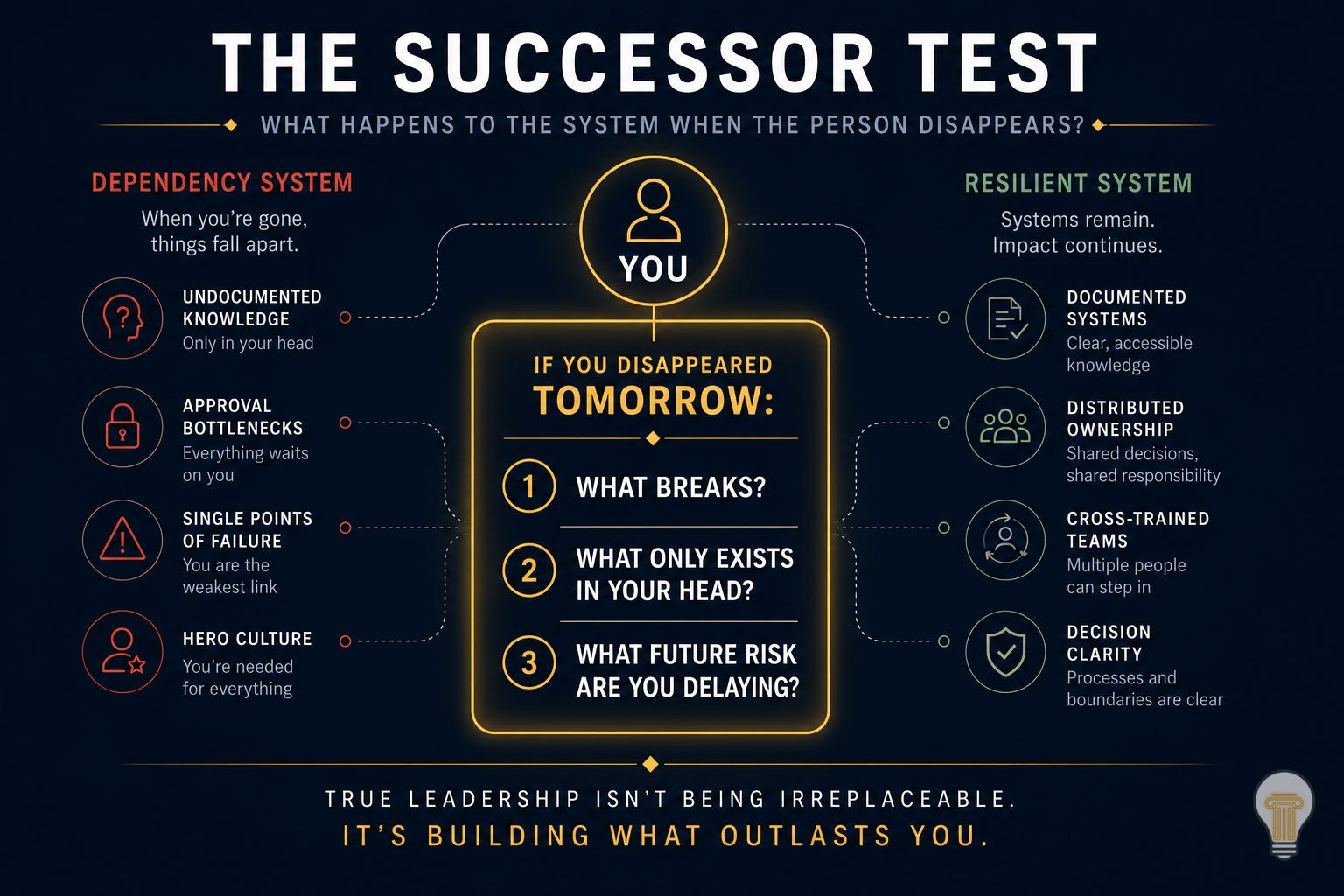
The Successor Test
Before making a decision, Horizon Thinking asks a set of questions, summarised as:
“What future condition does this create?”
Expanded, this creates the Successor Test.
1. If I left tomorrow, what would break?
This reveals hidden dependency.
2. What knowledge currently exists only in someone’s head or inbox?
This reveals operational fragility.
3. What decision am I avoiding because the cost is immediate but the benefit is future-facing?
This reveals Horizon Debt.
If the answer exposes repeated risk, build it into the system this week.
The Cathedral Allocation
Medieval cathedral builders spent entire lifetimes laying foundations for structures they would never personally see completed.
Modern leaders need the same orientation.
Protect time for invisible work.
Not eventually.
Now.
At minimum:
Spend one hour every week on work that produces no visible dividend today but reduces future fragility.
If you control team capacity:
Protect 10% of time for horizon work.
This might sound vague, so here are some examples:
documentation
cross-training
onboarding improvements
process simplification
technical debt reduction
succession planning
retiring obsolete systems
capability development
None of these feel urgent.
That’s why most organisations neglect it until a crisis forces attention.
What this looks like in practice
Documentation over dependency
Stop being the only person who knows how to fix the recurring issue.
Document the process.
Train someone else.
Reduce the dependency.
Knowledge trapped inside one person’s head isn’t expertise.
It’s operational risk.
Talent export over talent hoarding
Finite leaders hoard strong performers because it protects their local metrics.
Horizon thinkers develop people so effectively that they eventually strengthen the wider organisation.
If your best people can only succeed under you, you haven’t developed leaders.
You’ve built dependency.
Maintenance before visibility
Short-term leaders chase launches.
Horizon thinkers protect infrastructure.
They invest in:
cleaner systems
better onboarding
clarified ownership
simplified workflows
reduced technical debt
The future is usually lost through neglected maintenance before it is lost through failed innovation.
Killing zombie projects
Some initiatives survive long after their strategic value has died.
Nobody wants to kill them because:
they are politically attached to someone senior
resources are already sunk
ending them feels like admitting failure
But zombie projects consume:
budget
attention
energy
strategic oxygen
Sometimes the most future-facing act is not starting something new.
It’s ending something that should already be dead.
The unsettling reality
Horizon work is difficult because the rewards are delayed and often invisible.
You may never receive recognition for:
the disaster that never happened
the onboarding failure that never occurred
the knowledge gap that never became catastrophic
the staff burnout prevented by better system design
But this is what mature leadership looks like.
Not constant visibility.
Structural stewardship.
The work should not need your presence to survive your absence.
The mandate
Look at your immediate sphere of influence.
If you disappeared tomorrow, what would become confusing, fragile, or impossible within seven days?
Spend one hour this week making that thing less dependent on you.
Write the decision rule.
Document the process.
Train the backup.
Archive the context.
Kill the stale commitment.
The future is not built through dramatic declarations.
It is built through accumulated acts of maintenance, transfer, and stewardship.
Continue the series
Horizon Thinking reveals what matters beyond the next deadline.
But once you can finally see the horizon, a harder problem emerges:
You cannot carry everything forward.
Next: Intentional Refusal
Why serious leaders must deliberately abandon the non-essential.
Start here: The Cognitive Firewall
I love this concept of a Horizon Debt, it's so powerful, and makes total sense.
Stoic thinkers like Epictetus have observed that “Happiness and freedom begin with a clear understanding of one principle: Some things are within our control, and some things are not.”
We can all think a bit further and a bit larger.