
Your Calendar Is Not a Strategy
Intentional Refusal — Part 5 of ARCHITECT: How to protect the work that actually matters

The most dangerous yes is usually a good one
A highly competent director gets invited onto three cross-functional steering committees.
They are asked to mentor two other departments.
Someone wants them on an innovation working group.
Another executive asks for “just a little strategic input.”
It feels validating.
Their expertise is recognised.
Their reputation is growing.
Their influence is expanding.
Six months later, they spend most of their week talking about work instead of doing it.
Their calendar is full.
Their strategic objectives are drifting.
Their deepest thinking now happens on Sunday mornings at the kitchen table.
Nothing failed dramatically.
That’s the problem.
The requests? Reasonable.
The people? Well-intentioned.
The opportunities? Genuinely good.
And yet, the cumulative effect was devastating.
Because the worst “yes” is rarely a bad opportunity.
It’s usually a good one.

Horizon Thinking requires protection
In the previous pillar, Horizon Thinking asked a difficult question:
What am I building that will still matter after I leave?
But there’s an immediate problem.
You can’t build for the future if your attention belongs to everything else.
A strategy you can’t protect isn’t a strategy.
It’s a preference.
Many leaders can articulate their priorities.
Far fewer can defend them.
That is where Intentional Refusal begins.
Capacity Capture
Most organisations suffer from a hidden structural problem.
The most competent people slowly become part of the institutional infrastructure.
I call this Capacity Capture.
Capacity Capture occurs when an organisation gradually absorbs its most capable people into everyone else’s priorities.
This rarely happens because of malice.
It happens because competent people are useful.
They:
solve ambiguity
navigate politics
fix broken processes
answer difficult questions
rescue struggling projects
So the organisation learns a rather simple lesson:
Give it to Alex.
Eventually Alex becomes the unofficial solution to problems they never created.
The result is predictable.
Their actual mandate receives whatever attention remains after everyone else’s “priorities” have been serviced.
Collaboration becomes overload
This isn’t just anecdotal.
Research published in the Harvard Business Review found that in many organisations, between 20% and 35% of value-added collaboration is generated by just 3% to 5% of staff (Cross, Rebele & Grant, 2016).
The most capable people become collaborative bottlenecks.
Everyone needs their input.
Everyone wants their time.
Everyone believes their request is important.
Individually, the requests seem reasonable.
Collectively, they become impossible.
The organisation calls it collaboration.
Someone looking at your calendar might call it something else.
The meeting is not free
One of the biggest misconceptions in knowledge work is that a meeting costs only the time allocated to it.
A 15-minute meeting is not a 15-minute cost.
It’s an interruption.
It’s a context switch.
It’s a fracture line through whatever focused work existed before and after.
Psychologist Sophie Leroy describes this phenomenon as attention residue.
When we switch from one task to another, part of our attention remains attached to the previous activity, reducing performance on the next task (Leroy, 2009).
This matters more than most leaders may realise.
The cost of a meeting is not the meeting.
It is the strategic thinking, writing, analysis, and judgement that needs to recover afterwards.
Three “quick chats” can quietly destroy an afternoon.
Not because the meetings were long or particularly taxing.
Because those interruptions were expensive.
Intentional Refusal
This is where the fifth pillar begins.
Intentional Refusal is the disciplined protection of strategic capacity from requests that are useful, flattering, or urgent but misaligned with the horizon.
Notice what this isn’t.
It’s not:
selfishness
avoidance
stubbornness
refusing all collaboration
Nor is it hiding behind some sort of “deep work” while the institution burns.
Intentional Refusal isn’t an absence of generosity or “being a team player”.
It’s generosity governed by judgement.
The goal isn’t to help nobody.
The goal is to help selectively enough to ensure your highest-value work still gets done.
Seneca diagnosed this problem 2,000 years ago
In On the Shortness of Life, Seneca observed that people carefully guard their property and possessions, yet waste time with astonishing carelessness.
Modern organisations have taken this tendency and industrialised it.
Nobody walks into your office and steals six months of your life.
It’s more polite than that.
One committee.
One working group.
One recurring meeting.
One favour.
One steering committee.
One mentoring request.
One more calendar invite.
The loss is incremental and compounding.
Which makes it difficult to notice.
And also difficult to resist.
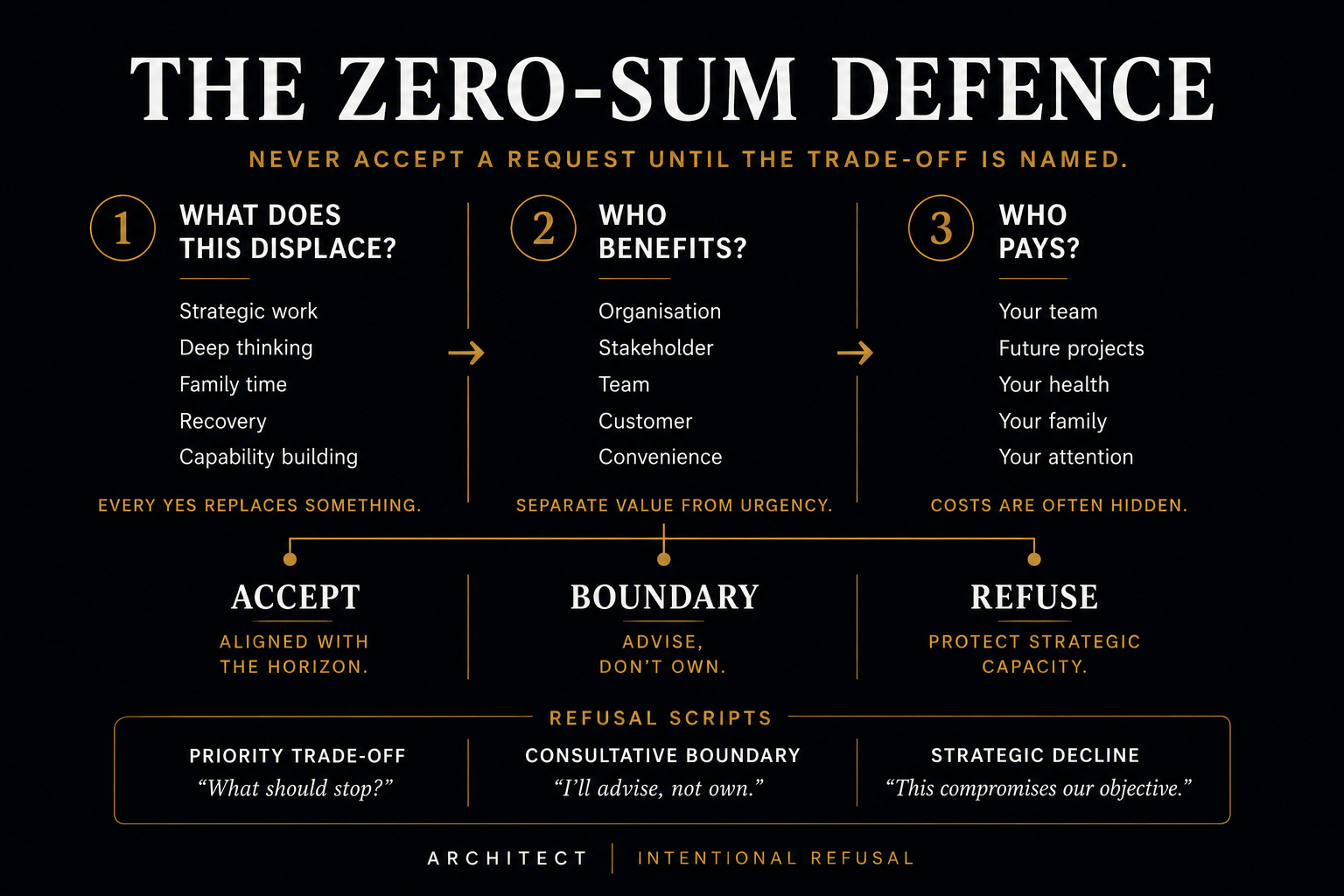
The Zero-Sum Defence
Before accepting a new commitment, ask three questions.
1. What does this displace?
If the answer is “nothing”, you are almost certainly deceiving to yourself.
Every commitment replaces something. Some other activity or
The question is whether you are willing to name it.
2. Who benefits if I say yes?
This reveals whether the request creates genuine organisational value or just solves someone else’s convenience problem.
3. Who pays if I say yes?
Often the answer is:
your team
your family
your health
your strategic objectives
your effectiveness
The execution rule is quite simple:
Never accept a request until you’ve named the trade-off.
Refusal without career suicide
Many leaders avoid saying “no” because they assume it’ll be confrontational.
It doesn’t have to be.
Most of the time, refusal can be clarification.
The Priority Trade-Off
When a senior stakeholder brings a new request:
“I can take this on. To do it properly, I’ll need to pause the Q3 migration work. Which outcome is the higher priority right now?”
This forces leadership to prioritise rather than accumulate.
The Consultative Boundary
When expertise is needed but ownership isn’t:
“I can’t join the working group or own the deliverables, but I’m happy to review the final recommendation briefly before it goes forward.”
You provide judgement without absorbing operational drag.
The Strategic Decline
When the request genuinely conflicts with your mandate:
“I’ve committed my team’s capacity to our core objective this quarter. I can’t take this on without that outcome becoming compromised.”
Notice that the refusal is tied to the strategy.
Not a personal preference.
The Agenda Gate
For vague invitations:
“I’m at capacity for meetings this week. Send me the context, decision required, and three questions you’d like answered, and I’ll respond asynchronously.”
Most vague meetings dissolve.
Specific requests survive.
That’s exactly how it should work.
What this looks like in practice
Defending the team
Intentional Refusal is not just about self-protection.
It’s a tool of effective leadership.
When another department tries to convert your team into overflow capacity, your responsibility is to stand at the boundary and absorb the pressure.
Your team should not pay for your inability to say “no” upward or sideways.
Killing the brain-picking coffee
Most “quick coffees” are not quick.
Many are poorly defined requests.
Instead:
Force clarity.
Ask for context.
Ask for questions.
Move the conversation to writing.
The frivolous majority will disappear.
The important ones will survive.
Sunsetting legacy meetings
Audit recurring meetings.
Ask:
What decision does this meeting enable?
What would break if we cancelled it?
Could this happen asynchronously?
If nobody can answer, permanently cancel the meeting.
Refusing flattery
Many competent leaders are trapped less by fear than by praise.
“You’d be perfect for this.”
“Nobody understands this better than you.”
“We really need your expertise.”
”I need someone I can trust.”
These may be true statements.
That doesn’t mean the request is aligned with your horizon.
Flattery is not a strategy.
The uncomfortable truth
Most priority control isn’t lost through dramatic failure.
Instead, it’s a gradual process of accommodation and assent.
One, small, low-significant, but reasonable request at a time.
Until their calendar becomes a record of everyone else’s priorities.
And their own work becomes something squeezed into the margins.
Your calendar is not a strategy.
But it is evidence.
The real question is:
Whose strategy does it reflect?
The mandate
Open your calendar for the next two weeks.
Find one meeting, committee, project, or commitment you originally accepted because of:
guilt
habit
flattery
fear
Identify what it’s displacing.
Then use one of the Zero-Sum Defence scripts to renegotiate, reduce, or exit it before Friday.
If you can’t remove it, reduce your exposure to it.
If you can’t reduce it, clarify the trade-off.
If you can’t clarify the trade-off, you have found the real problem.
Most people think strategy happens in planning sessions.
It doesn’t.
For you, strategy happens every time you accept or decline a demand on your attention.
Every yes writes your future calendar.
Every yes decides what receives your energy.
Every yes determines what gets built and what gets abandoned.
As noted, Seneca observed that people guard their possessions carefully while giving away their time with astonishing carelessness.
The observation still holds today.
Time feels abundant because we spend it in fragments.
A meeting here.
A committee there.
A favour accepted without reflection.
But leadership is nothing more than accumulated decisions about where your attention goes.
Intentional Refusal is not really about saying no.
It’s about making room for what matters.
Horizon Thinking showed you where to steer.
Intentional Refusal protects your capacity to get there.
But capacity alone is not enough.
Eventually, you must decide what is actually worth protecting.
That’s where the next pillar begins.
Continue the series
Next: Timeless Core
Why principles matter most when the map runs out.
Start here: The Cognitive Firewall
Love this. Capacity Capture names something I’ve watched play out for years: the most reliable people end up as load-bearing walls nobody dares to move. Peter, how do you usually spot someone being captured like this before they reach breaking point?
What a compelling piece. Attention residue is a real thing and it's what I disliked the most about extreme multi-tasking, being pulled into every meeting, discussion and every training opportunity. I was the Alex in your story. I always felt I consistently needed 15-20 minutes longer on each project yet i was always being pulled over to the next, then the next. You've articulated the value of time incredibly well. Applause!